---
title: "Writing"
author: "Shane Breslin"
url: "https://read.shanebreslin.com/2/writing"
---
The Trust Series
#Trust Series, Part 1: Building Trust in an Age of Distrust and Distraction: Powering the Business-Trust-Brand Flywheel#
**Table of Contents**
In this essay:
- [The trust economy](#1-the-trust-economy)
- [What is trust, anyway?](#2-what-is-trust-anyway)
- [What Warren Buffett says about trust](#3-what-warren-buffett-says-about-trust)
- [The brand-trust-business flywheel](#4-the-brand-trust-business-flywheel)
##1. The Trust Economy##
We’ve had the fourth industrial revolution, and the passion economy, and the attention economy.
All of them are genuine.
But there’s something that’s as important as any of those, something that has always been important and is probably more important now than it’s ever been before.
**The trust economy.**
Trust is a vague, indefinable thing.
If you have it, almost anything is possible.
If other people place their trust in us, and just as importantly if we trust fully in ourselves, the ceiling that presses down upon us is lifted, and we begin to see the world in a whole new light.
But while we might all agree on how important it is, the questions remain.
How do you build it? How do you nurture it? How do you take the first steps to getting it in the first place?
Where do you start with something as silent and invisible as trust?
The place some people go is an old favourite.
###The Know-Like-Trust Framework###

It’s a common device.
In order to do business with you — and let’s take “doing business” more broadly than just commerce here, because it includes all kind of relationships — the old wisdom is that people first need to know, like and trust you.
It’s a three-step process.
First, because they don’t know you, they’ve got no idea who you are, what you’re about, or what you stand for.
Then, one day, they do. They start to know you, a little at first. Step 1.
Whether it’s through a tweet, a random conversation, an introduction by a mutual acquaintance, or just returning your slow second serve at the tennis club, they get to know you a little.
Next, if you’re lucky, they approve of you, whether that’s an unconscious decision or not (and to be clear, this decision, like most of our decisions, is almost always an unconscious one). That approval marks the move to Step 2. They begin to like you.
Over a little time — because time is a force multiplier here — things progress smoothly enough and from not knowing you (Step 0), to knowing you (Step 1), to liking you (Step 2), then there’s a chance things might progress up to the apex of the pyramid: they begin to trust you (Step 3).
Frameworks like these can be useful.
Like stories, frameworks help us make sense of things that previously looked like a mass of confusion, and making sense out of confusion is a key part of the human experience of the world.
###The Human Element###
But the know-like-trust framework is simplistic.
Where people are involved, as they are in a three-dimensional way at every stage of know-like-trust, we need always to take into account the endless combination of competing desires, biases, moods and emotions of everyone involved.
Each stage of the know-like-trust framework is a fragile place to be.
Firstly, all of us are fickle, beholden to jetpacks of hormones and moods and opinions and influences, from inside our own bodies and minds, and from the thoughts of others that are projected incessantly into the world through conversations and media and online social networks.
So it’s not at all impossible that someone who likes you today might like you less, or not like you at all, next week, and it might have very little to do with you at all.
Secondly, even a little distance or absence from either party can result in everything being pared back or dissolving entirely.
People might get to know you, and then get to like you, but if for some reason you or they are absent or otherwise occupied for a while, they might feel like they no longer know you so well at all, and the dissolution of the know factor causes an instant dissolution of the like factor too.
And that’s when you and they are still in the realm of know and like, even before you get to the altogether more complex factor of trust.
##2. What is Trust, Anyway?##
There’s an old Joni Mitchell song, “Big Yellow Taxi”, about the creeping intrusion of commercialism on the natural world.
You probably know it. The recurring refrain goes like this:
> Don’t it always seem to go
> That you don’t know what you’ve got til it’s gone
Trust is like this.
We don’t really know it when we have it, but it will be obvious when it’s gone.
Stéphane Hamel is a techie, a data-oriented, digital privacy professional guy. I once asked Stéphane about the task of measuring trust in business.
_[Our email conversation prompted him to write a short article, under the title “Can we measure trust?”]
His focus was very much on trust in business, as opposed to the common-or-garden-but-not-so-very-different variety of trust among people.
Stéphane is plugged into the topic of trust in business at a deep level — the tagline of his consulting business is “All the world is made of faith, and trust, and privacy dust”.
I like his philosophical comments about trust.
> “Trust, like love, is hard to describe, but it’s easy to know when it’s lost. Trust, like engagement, is hard to describe because it varies so much depending on your personal values, culture, life events and such. Trust is a quality, not a quantity.”
Trust is hard to describe.
And it’s a quality, not a quantity.
##3. What Warren Buffett Says About Trust##
Warren Buffett, to many the greatest investor the world has ever seen, once said:
> “It takes 20 years to build a reputation and five minutes to ruin it. If you think about that, you’ll do things differently.”A good brand is an established positive reputation. And an established positive reputation is an essential ingredient in trust.
This is why branding is so important in business.
_**Branding is inextricably related to trust.**_
A positive brand is a brand that’s trusted.
When a company’s brand turns negative or even toxic, the first thing out the window is trust, and it can take massive investment, mass changes in personnel, and years, if not decades, for that trust to be rebuilt — if indeed it ever is.
We’ve seen this recently with the FTX / Sam Bankman-Fried crypto scandal. When CZ, the head of rival exchange Binance, tweeted that he was selling off all his FTT, the cryptocurrency created by FTX, it created a collapse in trust that saw tens of thousands of customers immediately queuing up to withdraw their funds, eventually exposing the vast black hole at the centre of the FTX finances.
But forgetting about basket-case crypto businesses, we don’t have to look far to see how great businesses leverage marketing to build trust.
Nike doesn’t buy ads just to encourage people to buy running shoes.
[Nike instead creates powerful short films with the former NFL quarter-back Colin Kaepernick](https://www.youtube.com/watch?v=ekZRoSCINLA) to create a powerful feeling in anyone who watches.
That feeling creates the brand, and the brand creates the trust, and that trust is lodged deep in your psyche and deep in your gut, and it contributes in a major way to your decision when you set out to buy some trainers.
The same goes for other great businesses everywhere, from the [McDonald’s Christmas ad of 2022](https://www.youtube.com/watch?v=92pdQJCdKvE), to [Purina, the pet food conglomerate](https://www.youtube.com/watch?v=G4Sn91t1V4g), to [Mattress Mick](https://www.youtube.com/watch?v=dgVWSQ4UrBg), the proudly lo-fi Irish bedding company.
##4. The Brand-Trust-Business Flywheel##
So branding is about much more than just advertising or marketing.
Branding is about shaping people’s perception.
David Ogilvy, the archetypal builder of brands, described branding as
> the intangible sum of a product’s attributes: its name, packaging, and price, its history, its reputation, and the way it’s advertised.
In that definition, the two words that jump out to me are “intangible sum”.
**Intangible**, because your brand is about so much more than what we can _see_ or _hear_ or _touch_. Mostly, it’s about _what we feel_, and _how we feel_.
And **sum**, because it’s very much an invisible form of mathematics: most of the time, the best we can hope for us an additional sum. This one good thing, added to that one good thing, added to the previous one good thing.
If you do it especially well, it becomes positively multiplicative, a viral and exponential network effect taking hold to raise your brand to new and previously unknown and unexpected levels.
Occasionally, it becomes subtractive, when one mediocre thing takes away from the whole, and another, and another, and if that keeps going there is the risk of the divisional collapse, a negative tipping point where contagion sets in and reputation hits the floor, something that can happen, as Buffett suggested, in a matter of minutes.
Within all this, it is possible, I think, to create a flywheel effect, where the first thing causes the second thing to happen, and the second brings about the third, and the third in turn causes the first to happen once again, and on and on with perpetually gathering forward momentum.
This flywheel might look something like this.
Investment in branding builds trust, and that trust leads to an increase in business, that extra buffer on the bottom line allows the business to re-invest in brand again.
That investment builds more trust, which builds more business, which allows more investment, and the flywheel continues to pick up pace with every trip through the cycle.
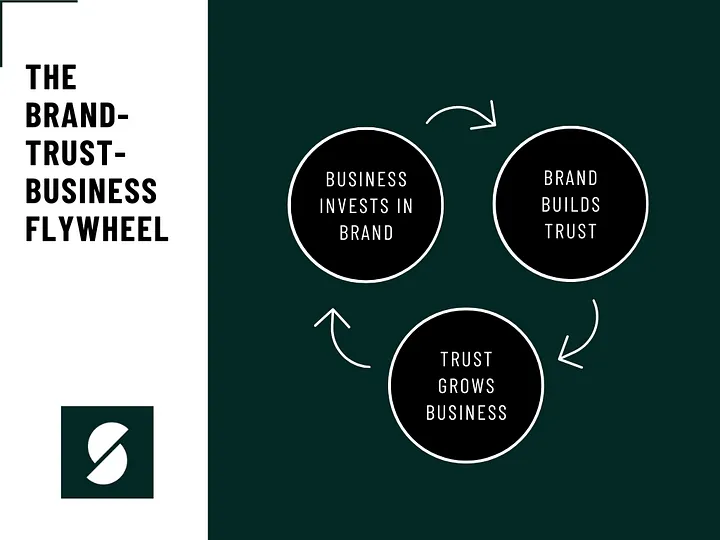
An incomplete understanding of business and branding misses out the trust step, and whenever a step is missed, the entire flywheel comes crashing to the ground.
That incomplete understanding suggests that it’s a two-way give-and-take: that branding builds business, and that business invests in branding.
But this misses out the key ingredient: trust.
A branding exercise that does not build trust is a failed branding exercise.
Of course it’s easy to look at big, established businesses — Coca-Cola, Nike, Tesla, Patagonia — and understand with the benefit of time (and a generous helping of [“survivorship bias”](https://www.bbc.com/worklife/article/20200827-how-survivorship-bias-can-cause-you-to-make-mistakes) too) all the elements that added up to the brand, that _intangible sum of everything_, that exists in the world today.
But if you look carefully, you might be able to peel back the layers and see examples of how brands were built from the ground up.
Take this example of an ad run in the 1980s by an agency acting for an up-and-coming but then completely unknown fashion designer.
What are the hallmarks of Tommy Hilfiger, the world-famous and well-established brand of the 21st century? Would they include a brazen sort of cockiness, an unshakable confidence, a commitment to individuality, a general fearlessness of taking on the status quo?
Those hallmarks are all there in this 1985 ad, which was designed “to create a fashion celebrity in a few weeks”, and probably succeeded in that aim.
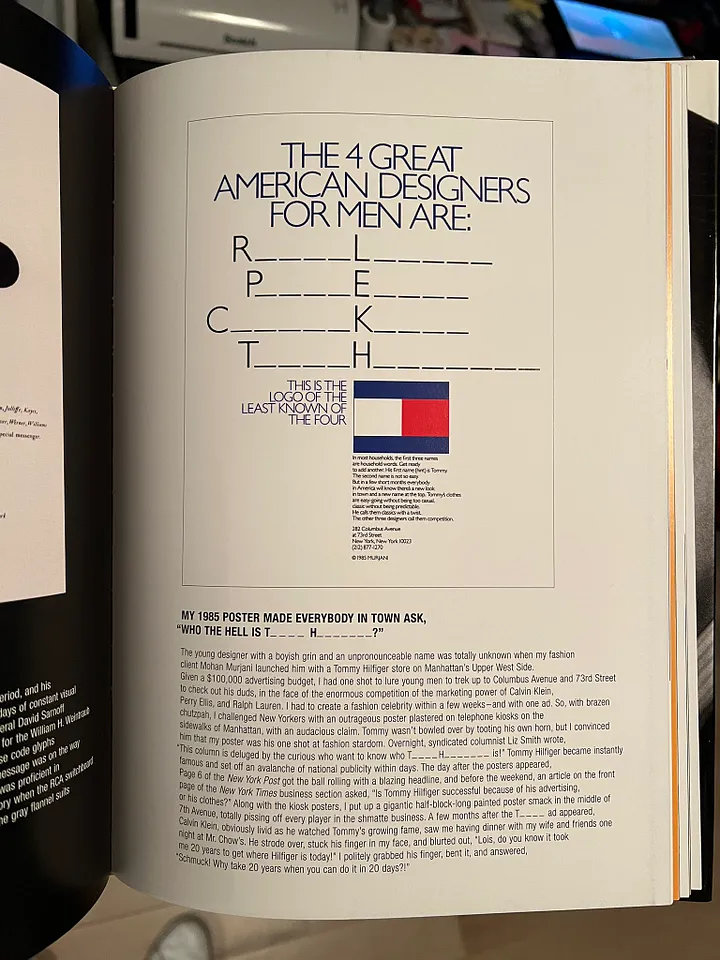
Tommy Hilfiger and his brand agents and his business operatives — everyone involved, all together — still had to do the hard work that adds up to trust.
They had to deliver on their promise every time. They had to be consistent, even when they were pushing boundaries. They had to offer surprise without shock.
To sum it all up in a tl;dr line or two, it might be simply this.
**To develop trust, be trustworthy. Trustworthy does not have to mean good. Trustworthy just means being fully aware, at all times, of all the promises you’re making, with or without words, and to fulfil each one, one at a time, forever.**
_Thank you for reading all the way to the end. My name is Shane Breslin. I write for globally ambitious businesses, helping them elevate their brand through writing that reaches for the stars. If you run or own a globally ambitious business and you’d like to talk about how I can help, [please get in touch](https://shanebreslin.com)._
#Trust Series, Part 2: How the Dynamic of Trust Has Changed in Our New Global Village#
Table of Contents
In this essay:
- [Cold ice-cream on hot days](#1-cold-ice-cream-on-hot-days)
- [The existential origins of trust](#2-the-existential-origins-of-trust)
- [How trade made money a proxy for trust](#3-how-trade-made-money-a-proxy-for-trust)
- [Choosing the right terrain in the fight for trust](#4-choosing-the-right-terrain-in-the-fight-for-trust)
- [How to avoid being slave to modernity’s masters](#5-how-to-avoid-being-slave-to-modernity-s-masters)
In the first part of this series of essays on the concept of trust in business, I tried to peel back some of the layers on what exactly trust is, outlined the ideas of the trust economy, considered how fragile trust can be, and described what I think of as a “flywheel” that can help all businesses build trust, and leverage it, in a way that is aligned to your values and long-term sustainable.
In this essay, Part 2, I try to take a macro view of the past and the present of trust, between people in general, and between people and businesses in particular. I will consider the role of trust in the millennia-old history of commerce and society and of civilization itself. I will try to identify the current state of play with trust in business. And I will pose some open-ended questions about how businesses, especially small businesses, should adapt to the increasingly global, increasingly technologized and increasingly fragmented world all of us now live in, and do business in.
##1. Cold ice-cream on hot days##
Cole Schafer is a writer I admire. By day he is a copywriter-for-hire, by night a writer of heart-raw poetry.
One of his products is a copywriting course titled:
> “How to write words that sell like a Florida Snow Cone Vendor on the hottest day of the year”
In Ireland, where I’m from, none of us ever use the term “snow cone”. But almost all of us, wherever we are, are familiar with the unimpeachable allure of an ice-cream cone on a hot summer’s day.
Implicit in the transaction, as we stand in line waiting for our snow cone (or, the staple in Ireland, a “99” with strawberry syrup and chocolate flake), is an almost unbreakable form of trust.

Both of us trust that we will get exactly what we came for: that the ice-cream man will give us what we want; that we will pay up without gripe or discussion. It’s the simplest of transactions, with zero influence, persuasion, or compulsion.
We want it. He has it.
Transactions like this are rare. In almost every transaction, every day of every week, there are countless points of friction.
Go to repair a tyre, and you might wonder how much you’ll be charged, or whether the tyre mechanic might advise you — a little prematurely, or a lot — that the tyre is not worth repairing, and while I was at it, I took a look at the rest, and you could be doing with a new one on the front left as well. Go to fill the car, and you might compute the price-per-litre on the roadside LED and try to recall the price at the other station back up the road and wonder about the whispers you heard somewhere sometime about the quality of the fuel in these particular pumps. Go to the supermarket for milk and bread and you might have an insistent voice in your ear about the ways store designers position such everyday essentials beyond or alongside some small luxuries, such that your two-item list soon becomes a basket of goods that forces you to leave the coins in your pocket and pull out the debit card instead.
In a lifetime, we fight small silent battles like this a million times. Each fight is a fight with trust at stake.
Trust is rare. Trust is powerful. And because of how rare it is, and how phenomenally powerful it is, trust is effectively priceless.
Trust is effectively priceless in two important ways.
In one way — the obvious way — trust is priceless because it can’t be bought. Money can influence, of course. Provided it’s put to good use, money can create the environment, the systems and the personnel that nurtures the growth of trust. But trust is a great intangible, perhaps the greatest intangible, and great intangibles can never be plucked from the shelf and paid for at the till.
In the other way, the much less obvious way, trust is priceless because it’s a deeply psychological and evolutionary concept that predates something so new and modern as price.
##2. The existential origins of trust##
The Junto Institute, an organization whose stated purpose — like an Olympic movement for organizations rather than athletes — is “to help leaders and their teams become infinitely better, smarter, and healthier”, spent some considerable time and energy developing a comprehensive wheel of human emotions.
In it, the institute attempts to deliver a complete spectrum of emotions, building extensively on the four basic emotions outlined by the turn-of-the-century American philosopher and psychologist, William James (fear, grief, love and rage). The Junto Emotion Wheel includes 108 emotions, broken down into three tiers: a top tier of six (love, fear, anger, sadness, surprise and joy), 34 second-tier emotions and 68 third-tier emotions. The wheel includes everything from hostile to zealous, awe-struck to tranquil, bewildered to tender.
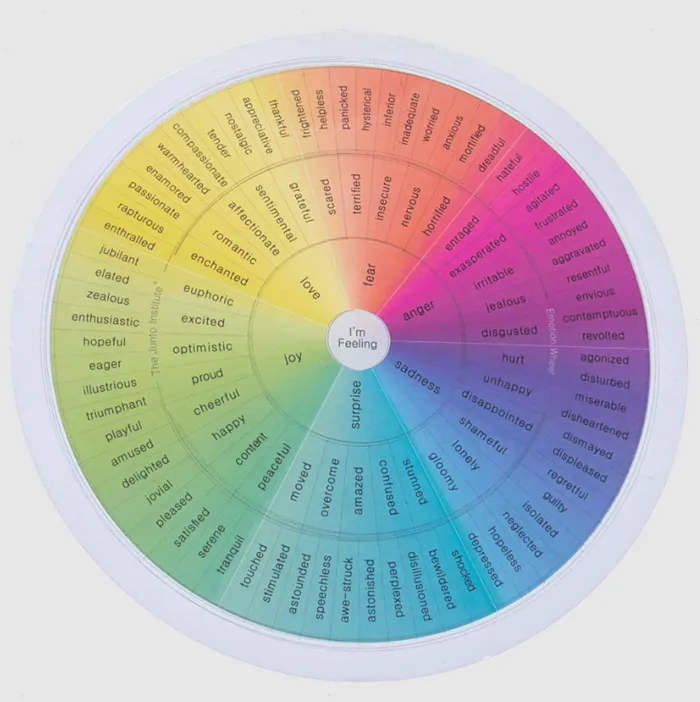
There is one notable absence on the Junto Emotion Wheel, though: trust is nowhere to be seen.
But is trust really an “emotion”, you might object.
Many who have studied it in detail say that not only is trust an emotion, but it’s an emotion that sits at the very heart of all human experience.
An influential earlier attempt to chart emotions in a colour-coded wheel, developed by the psychologist Robert Plutchik in the 1980s, included trust as one of eight primary human emotions, alongside anger, fear, sadness, disgust, surprise, anticipation, and joy.
Plutchik was motivated by theories that would lead to one of the newest branches of science, now known as evolutionary psychology. These eight emotions, the Plutchik methodology argued, had “high survival value”. While love — not included in Plutchik’s central eight, but represented elsewhere as an alloy of trust and joy — is obviously a powerful emotion, its value for species survival is, he surmised, questionable, or at least not core. (If we consider the reproductive drive as the central thrust of the genepool, and remember that one of the most widely selling books of all time is _The Joy of Sex_, we can understand that while love might be a welcome addition to sex, it is joy and its close cousin ecstasy that are — psychologically and reproductively —the key driving forces for reproduction.)
Compared with joy, or fear, or anger, trust plays a different role, but one that’s just as powerful.
Without trust, our distant ancestors were, all too literally, dead meat.
Trust allowed humans to keep each other safe from the predators and other existential threats that were everywhere in the primitiveness of their environment. If you and I were hunter-gatherers fifty thousand years ago, and we did not have each other’s back — if we could not trust each other implicitly — both of us were very likely doomed. It’s for this reason that trust often bypasses the thought processes of our brain and goes right to our gut and to our hearts.
And it’s because trust is felt within our bodies rather than our minds that scammers and shysters everywhere go to great lengths to win our confidence, to nurture our trust, not by appealing to the logic valued by our so-recently-developed prefrontal cortex, but by tugging on the deeper body psychology of our heart tissue and gut lining, those parts of the body where many decisions are made, parts of the body that seem to have a direct line to the brain neurons in ways that biology and medical science are only just beginning to understand.
All of this invites multiple questions, then.
Given that trust sits at the core of our survival and prosperity, how is that need being met in the increasingly globalized, hyper-connected society of the 21st century’s third decade? How is that need being massaged? How, on occasion, is that need being shortcutted?
The rest of this essay will attempt to answer to those questions. To answer them, though, let’s first take a look at a few of the vital ingredients that add up to a powerful trust recipe: the need for familiarity; the lure of safety; and the magnetic attraction of eye-to-eye human connection.
###Familiarity###
To build trust with somebody, we need to know them. This knowledge manifests as a familiarity that requires no words and no explanation. Familiarity is itself assembled with a couple of building blocks: integrity, plus time. If somebody acts in accordance with their words, and does so over weeks or months or years, trust builds gradually and powerfully. If somebody you meet does what they say they will do, and does so repeatedly, trust naturally grows. When the opposite happens, trust dies.
In business, the most successful brands understand this. They understand that there is no substitute for familiarity. They understand that the old saying, “familiarity breeds contempt”, does not apply in the world of business brand-building.
###Safety###
To trust somebody, they must at some level make you feel safe. At some deep and maybe inexplicable level of your physiology, your body’s cellular response when the scent of a favourite old Ralph Lauren aftershave hits your nose is the same cellular response your distant ancestor felt when he hid in the undergrowth from the saber-toothed tiger and spotted several of his clansmen approaching armed with spears to take out the enemy.
To trust, you need safety. You might find great excitement in the new and unpredictable, but safety comes from the familiar and predictable, and safety is a feeling that humans, in general, appear to cherish above almost all others.
###Eye-to-eye human connection###
Building on the familiar and the safe is the power of standing face-to-face with another human being. The old adage goes that the eyes are windows to the soul. Vision is arguably as close as biology gets to the divine.
(There’s a line in Charles Darwin’s _The Origin of Species_ — _“To suppose that the eye with all its inimitable contrivances for adjusting the focus to different distances, for admitting different amounts of light, and for the correction of spherical and chromatic aberration, could have been formed by natural selection, seems, I freely confess, absurd in the highest degree.”_ — which some have interpreted to mean that only a creationist God could have created such a perfect instrument.)
The eye developed over 500 million years of evolution. Language, in contrast, is believed to be around 100,000 years old. Writing was developed around five thousand years ago. All this to say that communication through sight — the capacity to say a thousand things without a spoken word — goes to the heart of our animal history. If you have something vital to tell me, you will look me in the eye to do it.
It is these ingredients — these three vital factors that add up to the great intangible we call trust — that brands everywhere are trying to create, and sometimes shortcut, in the globally connected world of today.
Multinational brands invest millions, fine-tuning messaging and applying it consistently across many mediums and many years, to make themselves familiar to you, to represent safety for you, and to look you eye to eye — through the television on the wall or the screen in the palm of your hand — even if your eye is met not by the eye of the coffee company chief executive but by the eye of George Clooney, who brings with him the priceless boon of several decades of familiarity and safety hard-earned through other work in other places.
But now, everything about the way we have lived for millennia is being tipped up and torn apart, and the timeframe is much too short for our genes and our cells, for the very way we are built for survival, to adapt.
And this applies just as much to your business and mine as it applies to any other facet of human experience.
##3. How trade made money a proxy for trust##
Let’s consider for a moment the survival and prosperity of human beings long before our technological present. The industrial revolution that started sometime in the second half of the 1700s and continued until succeeded or overlapped by the technological revolution that started sometime in the late 1800s — these several successive centuries of mechanized, computerized, systematized progress overtook and often discarded the way things had worked in much of the world for many millennia.
For approximately 99% of human life on earth, men and women were hunter-gatherers, killing or collecting what they needed to survive on a daily basis. With the birth of agriculture around the world circa 10,000 years ago, things started to change, rapidly and irrevocably. Suddenly — or as near to suddenly as possible across the wide expanse of human history — people began to specialize: one person grew grain and cereals, another nurtured and butchered livestock, another produced milk and butter.
Trade between these farmers allowed many more people to prosper, to a greater or lesser degree. In the days before laws and statutes, there was still a contract, albeit an unwritten one.
That contract was trust.
There could be no comeback on a trust broken, at least none that didn’t include vengeance and bloodspill. Trust was easier to come by when the trade was local. That guy raising dairy cows over there, who wanted to barter some of his butter for a batch of your grain, well you knew his father and his grandfather before him, and he knew yours, and those connections and those years counted for everything.
The development of metal coins sometime in the 1000 years before the birth of Christ made international trade possible for the first time. Along the five thousand miles of the Silk Road that developed between modern day Istanbul in the west and China in the east, through Mesopotamia, Persia and India, coins of silver and gold developed a value that was understood by both local producers and traveling merchants. Between people who did not know and cared less about each other’s grandfathers, these coins could fill the role of trust. Once they were the right material and the right weight, the selling party might trust the buyer.
In a pattern that will be familiar to all of us today, as soon as a new technology develops a way of scamming that technology quickly follows. Counterfeiting coins, often through plating valueless base metals with a coating of precious, was so immediately prevalent that the art or craft of creating fake money has become known as “the world’s second-oldest profession”.
By now, however, ruling parties everywhere had been sold on the far-reaching benefits of trade — especially all the tax and tariff windfalls that came with it — and so they moved decisively, making counterfeiting a treasonable crime punishable by death. (Not that governments were above a bit of monetary fraud themselves, if they could justify it. During the American War of Independence in the 1770s, the British flooded the market with fake dollars with the aim of forcing the value of the enemy’s currency to plummet, a tactic repeated by the Union side against the Confederate dollar in the Civil War almost a century later.)
Over these several thousand years of international commerce, three truths have become absolutely apparent:First, that trade is beneficial to both parties, with economic prosperity becoming the engine for progress in all other domains.
Second, that trust is an integral part of trade, and that in the absence of the time factor — or “grandfather bond” — something must be adopted to serve as a proxy for trust.
And third, that somebody somewhere will always try to scam the system, or short-cut that trust, forcing societies to make dealing effectively with the scammers and fraudsters a central requirement of governments, and prompting a centuries-old battle that has long been fought and never been won by any government, anywhere.Whether it’s government-sponsored international fraud, a company implementing systematic processes to mix low-grade cane into its supposedly premium coconut sugar, or the streetsmart confidence trickster, the “con-man” trying to separate you from your wallet at the train station, there is always somebody trying to sell you a story of trustworthiness so they can abuse your trust.
##4. Choosing the right terrain in the fight for trust##
Which brings us to today, and how people everywhere might negotiate this daily and age-old personal battle — who to trust, why to trust them, and how to reduce the risk of having that trust abused — in a world where we’ve gone from a local village to a global village, where the local mall is quickly being replaced by the Internet Everything Store, where in an hour we might get paid for services supplied to a company in Michigan and buy a gadget from another in Hangzhou, without ever speaking to anyone or stepping outside your front door in the Irish countryside.
Understanding how we negotiate this new reality, where almost everything has changed but where trust remains as important as ever, is essential for the survival and prosperity of all ambitious enterprises, whether you’re harvesting coconut sap in Java, providing bookkeeping services from a suburb of Jerusalem, or teaching real estate investment in Jacksonville.
In our newly global village — and wholly subconsciously — we seek out what’s familiar and what’s been shown to be safe. We seek out not the ephemeral world of ideas or concepts, but the eyes of somebody we trust — even if we don’t know that’s what we’re doing, even if we might never in our lives be in the same room as that somebody. And through familiarity, safety and the eyes of a human being into whose hands we are happy to place ourselves, trust is built block by block by block.
You might have stern reservations about the working conditions in Amazon warehouses, but those thoughts will always sit squarely in your prefrontal cortex, while what Amazon gives you every time you click “Buy” goes beyond that, to the older parts of your brain and to the other primitive “brains” that sit somewhere below your neck and above your waistline. And so every year, won over by the trust they have for Amazon, more and more Christmas shoppers do all their shopping there. Whatever you might think of the anti-freedom policies of PayPal, people all over the world are only happy to enter their credit card details when they are reassured by the sight of those big blue “P”s.
For small businesses in particular, so much of this seems to be bad news.
After all, it is abundantly obvious that a key paradox of the Internet is that it increases concentration at the same time as it increases choice. The network effect is compelling. A sort of Internet-enabled Pareto principle on steroids takes place, where the overwhelming majority of the business is conducted by an ever-decreasing number of trusted entities. (Apple’s market capitalization — $2.75 trillion as of September 2023 — is higher than the GDP of all but seven countries in the world. Alphabet, the parent company of Google, is worth the same as the entire 12-month output of Spain, a historic superpower and modern industrial country with a population of about 50 million people. More than a third of the dollars spent online in the US are spent on Amazon.)
Every industry has a few standout companies who hoover up the majority of the brand recognition, and thereafter the majority of the business, and thereafter re-invest in the systems and efficiencies that allow them to keep the flywheel spinning.
What are the rest of us to do? Throw in the towel? Look at the odds stacked against us, contemplate how impossible it is to compete with Amazon or Apple or whatever 500-pound gorilla dominates your sector, and give up?
Some will, inevitably.
If you choose not to — and if you’re still reading, I can only assume that you have already made your choice — you must be aware of the terrain on which the battle for the trust of your customers (existing and future) is taking place.
Yes, the old high-street bookshop cannot compete with Amazon. Amazon offers an inexhaustible catalog, multiple format purchase options, Prime delivery, recommendation algorithms and thousands of reviews thoughtfully posted by people like you.
The old line about the putative fight between the bear and the shark applies. A bear can kill a shark, and a shark can kill a bear. The winner is decided by where that fight is fought. So if the old high-street bookshop tries to compete on Amazon’s playing field, it will lose. It has to take a leaf from the Sun Tzu book of war, or inspiration from the Che Guevara strategy of revolt, and go guerrilla.
You cannot compete with Amazon on their terms. But Amazon might not be able to compete with you on yours.
Your challenge, then — perhaps your most essential exercise — is to consider a series of simple questions that might not have simple answers.
What are _your terms_?
On which _playing field_ are you almost certain to win?
On what _terrain_ can you fight the trust battle and win?
##5. How to avoid being slave to modernity’s masters##
To answer those essential questions, it’s vital to remember one key thing about charting your course.
Subtly, even invisibly, the charts and signposts that are now deemed to be important have been decided by Google and Amazon and other Big Tech businesses fighting the unequal battle.
Everywhere now in the digital arena of business, we see mention of unique users, view counts, follower numbers, daily active users, market capitalization. Such metrics, and metrics like them, might seem important to you and your small, growing, ambitious company. But focus on them too much and you lose sight of the most critical measurement, the thing that perhaps must be measured more than anything else.
That measurement is both simple and fiendishly difficult.
**How, exactly, are you faring in the great competition for trust?**
Consider, for a moment, a couple of scenarios.
In the first, your video or brochure or article is seen by a tiny number of people, and noticed even less.
In the second, your business’s digital materials, through your slavish submission to modernity’s three-headed master of algorithm, advertising and analytics, is seen by tens of thousands of people (at least that’s what the view counts say).
Most businesses, if they’re really honest with themselves, are hovering somewhere close to the first and chasing the second.
In a world governed by Big Tech and its sky’s-the-limit race to the sun, it’s not at all obvious that there might be a third scenario, somewhere between total oblivion and viral view counts.
In this scenario, one perfect prospect finds a piece of content you crafted a year and a half ago, feels deep resonance with your worldview and ethos, sees what you have to offer, and wants exactly that.
This scenario is, of course, the best possible outcome for most enterprising and ambitious small businesses.
It is a million times better than oblivion, that’s clear.
But it’s also a million times better than the vanity massage offered by the data that told you a thousand people watched your video on LinkedIn last week. (Because hidden in that data is that those thousand people watched for an average of ten distracted seconds before scuttling off to some other part of the bottomless Internet oceanbed.)
This third scenario is out of sight for most businesses, who operate in a wider culture dominated by Big Tech and in thrall to the unfathomable “number”.
A successful future for your business, and mine, lies not in oblivion, and not in the vanity-laden mire of thousands of faceless and voiceless “followers”, but in the one powerful human connection we make today, the one we make tomorrow and the one we make the day after that, on and on over time.
If you want to play the game that has been mastered — financially and algorithmically, mass-psychologically and exploitatively — by the biggest companies in the history of the world, go right ahead.
If you want to play a different game, a game they cannot play as well as you, that choice is yours too.
It might look like a more difficult game to play, because you have to formulate and write your own rules and devise your own playing field, but it’s the only game you can win.
And in this game, by valuing above all the one-to-one connections you create across the countless invisible foot-bridges the Internet allows, you can finally allow the essence of trust — the emotion that kept your ancestors alive, that has evolved in splendid Darwinian perfection over a hundred millennia — to take its place firmly in your corner.
Thank you for reading all the way to the end. My name is Shane Breslin. I write for globally ambitious businesses, helping them elevate their brand through writing that reaches for the stars. If you run or own a globally ambitious business and you’d like to talk about how I can help, [please get in touch](https://shanebreslin.com/).
#Trust Series: The trust equation#
_Two vital things that add up to the one thing essential in every great relationship._
---
There’s a phrase commonly heard in branding and marketing fields.
> “The confused mind never buys.”
The thinking is that you must strive to be ultra-clear with what your brand stands for, ultra-clear on what your business offers. Because without clarity there is confusion, and the confused mind never buys.
Confusion, of course, can be overcome. It just takes a different message, a better value proposition, and hey presto, confusion disappears and clarity reigns.
What cannot be overcome is distrust.
Warren Buffett, he of all the billions, knows the potency of distrust. He once said:
> “It takes 20 years to build a reputation and five minutes to ruin it.”
Reputation, here, is what’s built on trust. As well as being built on trust, a good reputation creates trust.
But it doesn’t need a bad reputation to create distrust. All that’s needed is for a reputation to be lukewarm.
If someone starts to distrust you, it’s effectively impossible to make them trust you again.
Every buyer-seller relationship is built on trust — the seller agrees to provide the promised value to the buyer; the buyer agrees to exchange the monetary value to the seller.
Distrust is toxic.
If distrust seeps into either side of this relationship, it infects the entire relationship. The relationship built up over 20 years crumbles in five minutes.
With all this mind, it will be blindingly obvious that Trust — capital ‘T’ Trust — is an essential element in any business relationship you want to last.
If you’re here reading this, I’m almost certain you’re not a stall seller hawking knock-off fake leather handbags to tourists you’ll never see again. As I touched on in my series of essays on Naval Ravikant's famous tweetstorm "How to get rich (without getting lucky)", you’ll want your business relationships to last way beyond the latest transaction.
(As Naval put it in Part 6 of that thread, “Play long term games with long term people.”)
With this in mind, then, what is it that creates trust?
A simple equation comes to mind:
###Trust = Time + Truth###
Many would argue, and I wouldn’t disagree, that time is the most important thing. Others might say, and I wouldn’t disagree with them either, that truth fills this role.
In the context of business, though, or work — or love or friendship or anything else that’s based on long-term relationships that are mutually beneficial in a thousand intangible ways — nothing is more important, nothing provides more solid foundations, than trust.
Time is self-explanatory. It takes time to build the trust required for deep relationships. You don’t know how much time it will take, but you can be certain that it will take time.
Truth is more problematic. After all, what is truth? Is there one truth? Does everyone, as the progressive chatter seems sometimes to suggest, bring their own truth? Some people might say that Donald Trump himself — he called his own social network Truth Social, after all — is the individual more responsible than anyone else for the so-called “post-truth world”, but I’ve seen persuasive arguments that Trump is himself a creation of the post-truth world, not its creator.
And the world around us does seem to be post-truth. Fakeness, obfuscation, gaslighting and lies are everywhere. We live in PR-land, spin doctors and controlled narratives.
Ignore the obscene levels of fakery and survive, or pay attention and go crazy. Heads I win, tails you lose.
[The novel Catch-22](https://www.amazon.co.uk/Catch-50th-Anniversary-Paperback-2011/dp/B08R747937/ref=asc_df_B08R747937/?hvadid=696450770390&hvpos=&hvnetw=g&hvrand=2703957088513492089&hvpone=&hvptwo=&hvqmt=&hvdev=c&hvdvcmdl=&hvlocint=&hvlocphy=1007883&hvtargid=pla-1444836384639&psc=1&mcid=44cd3924310e33a4ad9566258c088246&gad_source=1) lampooned the insanity of World War II active service.
Catch-22 book cover poster.
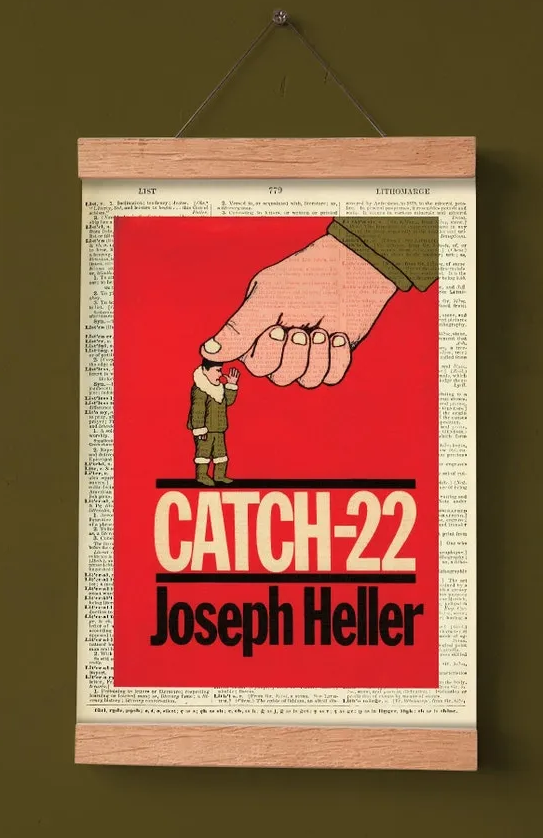
_Image via Coversandquotes / Etsy_
One of the most Catch-22 things of the social media age is how the idea of authenticity has itself been turned into a composable commodity. Manufactured, cookie-cutter, selfie-in-the-mirror authenticity might be the opposite of actual authenticity. Maybe there’s a literary descendent of Joseph Heller waiting to do the same for our screen-laden time, or maybe all of them have also been turned into buffoons.
So truth is problematic. It might be everywhere but still hard to find. We are so desperately inarticulate — me 100% included: I see Fee Sheet and everything I write here as one long futile attempt to write something fundamentally true — that we struggle to find the right words.
Without the right words how can we know something is true? Even on the rare occasion when we think we’ve found the right words, the other person often hears the wrong ones.
Still (and this may be naive), I have long believed that human beings have a sixth sense for truth.
Undoubtedly, many of us have not yet tuned in to that sixth sense frequency.
Many others have found the right frequency but can’t bring themselves to believe what they find there.
The best of us, those precious few, (1) see the truth, (2) see it as the truth, and (3) bring that truth into the open, knowing that it is what everyone seeks.
This, then, is the hard journey to a good life.
**Truth**, if we do the work of uncovering it, identifying it, believing it.
**Plus time**. Years, certainly. Decades, probably.
**Equals trust**. And all the wealth and bliss of experience to be found there.
Essays on technology
#It’s time to build beautiful: An essay on software and the world we live in#
**Table of Contents**
In this essay:
- Ideas as fragile mysteries
- Code, Covid and the global realignment
- The road to salvation
- The confused economist
- Beauty and the try-buy gap
##1. Ideas as fragile mysteries##
Like most people, Mikhail Bulgakov is complicated (or was — he died more than 80 years ago).
Born in Kiev in Ukraine, Bulgakov spoke and wrote in Russian. His play The Days of the Turbins was a favourite night out for Josef Stalin, who is said to have seen it 15 times in Moscow in the 1920s and ’30s. The play was banned in 1926 but the ban was later lifted after Stalin’s intervention, continuing its theatre run for almost 1000 performances.
For Bulgakov, it was not exactly triumph in his own lifetime — like all 20th century Russian writers and artists who did not tow the pro-Revolution, pro-Soviet line, he was marginalised, allowed only to work as a lowly production assistant at the theatre where his play was staged. Even so, he fared better than many of his contemporaries, who were exiled, executed or forced into hard labour in the Siberian gulags.
As Russia’s war in Ukraine continues, Bulgakov has come back into the consciousness of both countries.
There are at least two Bulgakov museums — one in Kiev, which exhibits more than 2000 Bulgakov possessions, photos, postcards and writings; and one in Moscow, a “writer’s house” museum in the apartment where he lived and wrote after moving there in 1921. In 2022, activists opposed to the way Ukrainians were portrayed in some of his writing campaigned for the closure of the Bulgakov House in Kiev in favour of a new museum that promotes pro-Ukrainian literature and culture.
You will, certainly, be wondering if there is some mistake here, and if there’s no mistake, what in all hell are we doing starting an essay about the present and future of software in 2023 by talking about a Ukrainian-born Russian writer who was working a century ago.
The reason is _The Master and Margarita_.
Written in a shroud of secrecy and first published in 1966 — decades after the author’s death and only after the tireless efforts of his wife Elena — the book is often cited as the greatest Russian artwork of the 20th century.
It is an unsettling, strange and darkly comic portrayal of a visit by the Devil to authoritarian Moscow — hence, the secrecy in the writing and the long delay in the publication.
For the past few years, when I think of software, I think of _The Master and Margarita_.
In the summer of 2020, I corresponded with a software engineer, entrepreneur and builder about something as apparently everyday as product development and user experience.
He said to me,
> “I always reach to literature when thinking about work. And when thinking about products, above all: Master and Margarita. You want to create an atmosphere just like Bulgakov did.”
This made my antennae buzz. I was a literature student back in the day, and all my working life has been in online media and communications. I asked for more.
He replied:
> “I cannot precisely explain. Oftentimes I feel like a lot of non-fiction boils down to recipes and when I’m reading literature there’s less agenda and less ‘actionable’ stuff. Of course I try to read literature for pleasure and reflection, but it finds its ways into my work … With most pieces of literature, I can usually at least summarise what I’ve read, but with Master and Margarita (I’ve read it twice) all I can think of is this purple haze, an atmosphere that’s present but not quite easy to grab.“I feel like it’s similar to how ideas and products take their earliest shape — you know what’s inside the less defined, and it’s a very personal experience. And I just prefer this ‘willingly unknown’ as opposed to ‘highly detailed’. Ideas are fragile mysteries, and so is this book.”
A few lines keep coming back to me.
**- When thinking about products you want to create an atmosphere just like Bulgakov did.
- With _Master and Margarita_ … all I can think of is this purple haze, an atmosphere that’s present but not quite easy to grab.
- Ideas are fragile mysteries.**
When it comes to software, and especially the type of software that relies on self-serve and automated onboarding, we hear plenty about user interface design and UX, about delighting the end user so much that it will lead to a type of bottom-up viral growth where customers discover, test and deploy a product to solve one precise problem in their workflow, and before long— best case scenario — become such staunch advocates of its benefits that they are the product’s de-facto chief marketers, selling it upwards and sideways in their organisations in an endless invisible cycle that seems to be ever-present and ubiquitous in the journey of every successful SaaS to unicorn status.
Scott Belsky, the founder of successful design portfolio platform Behance, wrote in his business/product development/entrepreneurial self-help book The Messy Middle:
> “The experience of using someone else’s creation comes from the path the creator took to make it. It is not the plastic, metal or pixels that make a successful product or service. Rather it is the thoughtfulness and tough choices made by the makers.”
At its best, software design and development is about much more than solving a specific problem, much more than UX and UI, much more than simply delighting the user.
It’s about the painstaking tasks, the depth of thoughtfulness and the endless array of tough choices made, that goes into creating an atmosphere.
In the two years of the Covid-19 pandemic, a trifecta of tailwinds created a global windfall for the software industry.
First, the pandemic fast-tracked the deployment of software that suddenly became a business continuity necessity.
Second, the injection of trillions of dollars of stimulus and credit to keep the global economy afloat.
And third, rock-bottom or even negative interest rates continued to force investors to seek higher-growth-potential investment vehicles for their cash.
As Blake Bartlett of venture capital firm Open View Ventures put it in one podcast:
> “It was an absolute sales bonanza. The biggest challenge was being able to effectively meet all the demand that was falling from the sky.”
With inflation and interest rates now jumping, energy availability and climate change on every front page, and stark warnings about the economic outlook in 2023 and beyond, the landscape has changed again.
Success for software startups — whether through a major acquisition by one of the big hitters or a billion-dollar IPO in your own right — has never been an easy path.
But the bar has been raised, and software entrepreneurs and teams must raise their game too.
And it could be that atmosphere — that “purple haze” that lies tantalisingly out of reach for most builders, at the far end of the user experience yellow-brick road — is the new terrain.
But before we plot a way forward, let’s consider exactly where we are, and how we got here.
##2. Code, Covid and the global realignment##
###Code###
Visualising the future is a difficult task. For most people, most of the time, it takes great discipline to cast your eyes and mind forward to a future and imagine it in any great detail.
Less widely appreciated, though, is that it’s often just as hard to picture the past.
It’s never easy to think in detail about the way things were. One of the reasons the past often seems rosier — when we talk about “the glory days” or someone’s “heyday” — is because of this inability to actually place ourselves into the reality of the way things were.
For one thing, all of the uncertainty that comes with every present moment, all of the million possible futures that are yet to play out, all that uncertainty disappears when we look backwards. From that single point in the past there now exists just one future — the one that crosses the divide from then to now — and therefore it can be impossible to bring ourselves back there.
So it’s almost impossible to place ourselves in August 2011, at the moment Marc Andreessen, technologist and venture capitalist, wrote a now seminal article in the Wall Street Journal under the heading “Why Software is Eating the World”.
What was going on in August 2011?
Much of Europe was three years into Brussels-sanctioned, IMF-approved austerity after the continent’s outliers — Portugal, Italy, Ireland, Greece, Spain, the so-called PIIGS — found themselves heavily exposed to the global financial crisis.
In Ireland, where emigration has traditionally been the preferred solution for economic devastation, hundreds of thousands of young people left for Canada, Australia and the US — which was already bouncing back from the worst of the financial meltdown that started in the creative productizing of Wall Street, perhaps spurred on by the perhaps fleeting optimism that greeted the election of Barack Obama.
In mediterranean Europe, by contrast, the young people stayed at home and entered the dark cycle of joblessness and economic badlands: youth unemployment in Spain and Greece peaked at a staggering 55% in 2013 and has since become endemic: in every year since then, approximately 1 in 3 young people are out of work. Italy’s youth unemployment rate has not dropped far below 29% any year since 2011. (Comparative figures demonstrate the depth of the crisis. In the UK, for example, the youth unemployment number never exceeded 25%. In the US, the worst year was 2010, when it peaked at 18.3%.)
Elsewhere in the world, the backdrop to 2011 was dominated, maybe most of all, by events in Islamic Asia and Africa, where first Osama bin Laden was killed by SEAL Team Six in Pakistan before that summer brought the Arab Spring, citizens rallying to overthrow leaders such as Hosni Mubarak in Egypt and Muammar Gaddafi in Libya, who had been in power for 30 and 32 years respectively, although similar civil unrest in Syria was mercilessly dealt with by Bashar al-Assad.
In all of these events — from the financial crisis that spread like a virus through Western economies to the early hopeful optimism of the Arab Spring — something central and vital could clearly be seen for anyone who chose to look.
In all of this, not just facilitating the events, but actively driving them, we could see the effects of technology — and behind the tech, the software.
In Europe, the depth and breadth of the problems were driven by the interconnectedness of the world’s financial systems, in which commercial banks from Athens to Dublin could rack up unsustainable debts that would require central banks and the IMF to come to some sort of rescue, even if the medicine might be as toxic as the malady.
The collapse of Lehman Brothers in New York was the domino that caused the European housing sector to sink into a morass of half-built apartment blocks, so-called “ghost estates” and big builders who had rapidly become big businessmen before just as quickly sinking into big bankruptcies. The pathogen entered the bloodstream in middle America before seeping, via Wall Street, through all the tech-connected veins of the global financial system. Decisions made in a New York office, relating to parcels of mortgages in Indiana, could bring financial meltdown to homeowners in Galway.
One recurring word that appeared in the commentary around the global financial crisis was “contagion”. Contagion was caused, more than anything, by the interconnectedness of everything. And what was it that created this interconnectedness? Code.
In the US, the creeping dissatisfaction that was a decade in development — a general unrest that would bring both Donald Trump to the White House and hundreds of thousands of mostly young men to early graves from addiction to the opioids that they hoped might have been balm to their unending psychological and physical pain — was beginning to foment towards an explosion of polarised division and civil unrest through online chatrooms and messageboards and the emotion-tugging algorithms of social media.
What was it that built the chatrooms and the messageboards and the social media platforms, and the apps and websites that housed them? Code.
In the Middle East and North Africa, even at the time the role of technology was heralded as important, even vital: rebels leveraged the borderless domains of Facebook and Twitter to organise and push for freedom. It was one of those moments, to misquote the Seamus Heaney poem serially popularised by US presidents Bill Clinton and Joe Biden, “when hope and history rhymed”. This rhyme of history and hope was facilitated and made possible by code.
This was the landscape that Andreessen, and many like him, saw and embraced in 2011, and which many outside the Internet and tech world struggled to comprehend. [Even a decade and more later, that lack of understanding in official corridors remains profound. in 2021, Mark Zuckerberg, the Facebook founder and CEO invited to Congress to answer questions about data breaches and the possibility of election influence via the social network, was asked by 80-something Senator Orrin Hatch, “If Facebook is free, just how do you make money?”, to which Zuckerberg replied, “We sell advertising, sir”.]
In 2011, the world’s biggest companies included retail giants like Wal-Mart and oil companies such as Exxon Mobile. (Microsoft was the only technology company in the top 10.)
In 2022, the top 10 biggest companies in the world by market capitalization include Apple, Amazon, Meta (Facebook), Alphabet (Google), Microsoft, Chinese tech giant Tencent and Tesla, which has been treated by stock exchange players more as tech firm than car manufacturer.
From Revolut vaults to Whoop straps, from Strava segments to McDonald’s ordering screens, code is in almost everything we do.
Software is no longer eating the world.
Increasingly, software is the world.
That is the motivation for Zuckerberg’s big bet on the future of Facebook: the metaverse, where we will live, work, eat, breathe and, presumably, copulate in an emergent new reality built in bits and bytes.
The challenge for most businesses is as simple as it is daunting: what will you do to survive?
The opportunity for software businesses is similarly straightforward: how can you take advantage?
###Covid###
Arriving into this maelstrom, at just about the exact point in time when it became clear that software was becoming the world, arrived Covid-19.
The most serious pandemic in a century, it brought a new and immediate mortality awareness to almost everyone on the planet, regardless of their age or prior health status. It fast-tracked changes to how we live and where, to how we work, where we work from and with whom we choose to share our precious time and germ-infested space.
Remote work and the ever-present Zoom room were the earliest manifestations of the Covid impact, with several downstream effects, including a clear and perhaps irreversible social distance between those who could live in peaceful seclusion, travel by private car and work from anywhere (or not at all), and those who found themselves locked into tiny apartments and had to brave the subway or bus to a job on the new frontline of supermarket tills and hospital wards.
The disenfranchisement and dissatisfaction of the masses, so clearly in evidence everywhere from mass youth unemployment in southern Europe, to the American opioid crisis, to anti-establishment votes for Trump, Brexit, Jair Bolsonaro, Marine Le Pen, Viktor Orban and others, could be seen in public discussions around Covid-19 too.
Mature reflection and open discourse was impossible to find. Indeed, what used to be seen as mature reflection and open discourse was often tarred with a broad brush marked “misinformation”, so much that those who sought deeper truths and asked questions about flawed or biased media coverage were scared into silence, or forced underground, or had their reputations tarnished in ugly character assassination hit-jobs.
In the environment that resulted, a climate of generalised fear of any outsider set in, where the outsider could be a migrant in a boat or a microbe in your body.
As with every era of fundamental change — the end of the Roman empire, say, or the gunpowder revolution — when things change utterly, they never go back the way they were.
Now, with climate change and out-of-control inflation, with supply chain fragility and energy shortages and central banks at war with their own governments, when we look at the real physical world outside our homes and offices, it’s easy to find problems that seem insurmountable.
Even the very act of being human — breathing, working, living, loving — is in flux, or soon to be. As Naval Ravikant, the investor and tech philosopher, says,
> “If they can train you to do it, eventually they will train a computer to do it.”
There are, as always, two ways to respond to flux. The first way, possibly the more tempting, is to fear it, and jump into fight, flight or freeze. The second way, arguably the more difficult, is to take up a pan full of silt and sand and soil, and look for the gold.
We can have certainty over few things in life but we can be certain of this: software will provide much of the gold.
In many ways, it already is. The stock market being the best long-term trends barometer there is, tech stocks remain in the ascendancy, even through the fall-out of the past two years. Bitcoin, the new money built on cryptography and globally interconnected computers, has been called “digital gold” for almost as long as it’s been in existence.
In the 1820s, the ability to read and write English became a massive competitive advantage. Historians might eventually say the same about reading and writing code in the 2020s.
This is the world that has been created in the past two decades and fast-tracked since the spring of 2020.
##3. The road to salvation##
> "Every crisis has both its dangers and its opportunities. Each can spell either salvation or doom.” — Dr Martin Luther King Jnr
There’s a popular TV show that has been running on Channel 4 in Britain since the early 1980s. Countdown is a words and numbers game where contestants have 30 seconds on the clock to solve a maths puzzle or make the longest possible word from nine random letters.
Suzie Dent, a pretty and softly-spoken lexicographer, has become a minor celebrity for her role in “Dictionary Corner”, where she provides the Oxford definition of rare words and, in every show, offers a segment called “Origins of Words”.
Whether she ever dissected the origin of the word “crisis” I don’t know, but crisis is a word that’s worthy of discussion. Crisis is typically seen as something uniformly bad, a negative spiral to make us hold on tight and see through to its conclusion.
Look closer, though, and there are much deeper, much more hopeful resonances to be found. The etymology of crisis goes back to the Ancient Greek κρίσις or krísis, which was “a separating, a power of distinguishing, a decision, a choice, an election, a judgment or dispute”. Krísis itself derives from the verb κρίνω, or krínō, which means “to pick out, choose, decide, judge”.
Suddenly, it doesn’t seem so bad.
Of course, if every crisis spells salvation for some and doom for others, there is sure to be plenty of pain and suffering and anguish.
But equally, a different road, the road to salvation — it’s up to you to say exactly what that means for you — is available. As always, it will be the road less travelled by.
For software companies willing to hold the present moment of converging crises to the light and see how they might take advantage, there are obvious tailwinds among the pressing difficulties presented by what many experts warn will be a deep and general recession.
Indeed, many of the tailwinds will be created by the difficulties.
While many industry sectors find themselves curtailed by the real-world gravitational pull of energy and transport and manpower, when the precarious checks and balances just one day stop adding up, software’s competitive advantage is likely only to expand exponentially.
It’s worth considering, too, how early in the technological revolution we still might be. It’s always tempting to look around at our present and think one of two things — one, that most problems are already solved; or two, that the remaining unsolved problems are already in the crosshairs of major companies with massive budgets.
John Collison, co-founder of Stripe, remembers being told during his company’s earliest days, that he was too late to the party, that all the spoils had been safely divvied up by Visa and Mastercard and Bank of America and all the other big financial institutions who dominated the global payments infrastructure.
In an interview with Patrick O’Shaughnessy on the Invest Like the Best podcast in 2020, he said:
> “When we were starting Stripe, one of the biggest obstacles we faced was people thinking ‘This is just a solved problem, there are already ways to accept money on the Internet, it’s the year 2009, I’m pretty sure we got this thing figured out.’”
Fast forward 14 years from those early challenges, and even with a 50% drop in its valuation in 2022–23, Stripe is still reputedly worth over $50 billion, making it one of the most valuable private companies in the world.
Now delete “payments” and drop in any of an endless list of problem areas: project management, profit & loss, budgeting, customer service, funding, cashflow management, indebtedness, general numeracy, political upheaval, travel, education, anxiety, depression, loneliness, dementia.
As the prescription drug side-effects sheet might say, everything “up to and including death”.
Can software solve them all?
Who knows.
But two points.
First, given the relative weightlessness of code in a world where the ability of fossil fuels to reduce time, space and gravity appears to be running out (or is, at least, an increasingly expensive and unpalatable choice), software will be centrally involved in solving all problems forevermore.
And second, for all that the iPhone and Stripe and WhatsApp and Slack, and countless SaaS products that offer everything from enterprise-architecture-in-the-cloud to solving one tiny recurring issue for a million bookkeepers, have cut through and succeeded in all their various markets, we are still firmly outside the ground floor of the skyscraper we’re building, gazing up to where the light from the rooftop restaurant of the future is peeping through the clouds.
##4. The confused economist##
> One of the things that really has everybody confused is, jobs are strong but growth is not. Productivity is just terrible! Is it because wages are higher than they seem, employers are distracted by the pressures to take on social issues, or just a global phenomenon? I don’t know what it is, but [there’s] a real disconnect between what’s going on with growth and what’s going on with labour.”— Kenneth Rogoff, Harvard professor of economics and former IMF Chief Economist on Fox News
Out of all of this flux and chaos, crisis and opportunity, what will emerge?
It’s hard enough to predict general workaday cause-and-effect, never mind second and third order effects.
Is it unreasonable to suggest that the present economic challenges of rising inflation and panicking central banks could lead to bankrupt governments, in turn morphing into a debt spiral that prompts bank runs, collapsed pension funds and global civil unrest?
Given a wide enough time horizon, almost nothing is unreasonable.
Looking at the present, though, it’s easy to say that the combination — alluded to by Ken Rogoff — of almost full employment and tapering productivity is impossible to sustain.
He suggests that employers might have become distracted by the new commercial imperative of CSR, but equally likely, perhaps, is that many companies have been given an artificial runway by dint of vast funding availability, zero interest rates and government stimulus.
Eventually, the law of the farm applies: as you sow, so shall you reap. Those weird “A Day in the Life of a Tech Product Manager” videos — like this one, with peppermint matcha lattes, sushi, green tea ice-creams, apple-ginger juices, a handful of meetings and almost zero work — might be more about carefully orchestrated recruitment-in-disguise, but even if they’re partially representative, then it’s easy to see where wheat can be separated from chaff.
All of this plays into the hands of software companies that are high on vision and agility and have the power to dance the line between minimal costs and maximal value.
To achieve that, there is some hard work to be done: the emotional labour that comes with difficult conversations about difficult problems.
The old Henry Ford joke about market research — “If I’d asked my customers what they wanted, I would have built a faster horse” — still has merit, but perhaps the most valuable skill of tech entrepreneurs, software engineers and product managers alike is the ability to download all of a prospect’s challenges, identify the underlying problem that has yet to be clearly articulated, and solve for that.
Hidden in this netherworld the express train to productivity, value and growth — and, just maybe, a billion-dollar IPO — awaits.
Playing a big part in whether you get there, or not, is old and undervalued skills: how you think about things, how you ask questions, how you listen and observe.
##5. Beauty and the try-buy gap##
To finish, let’s go back for a moment to the place we started: the “purple haze” that might represent a desirable atmosphere within a product.
For many software builders, high on left-brain rationality and logic, the functionality of the thing is all-important. As an old web developer friend used to say, “If it runs and works, it runs and works.”
This, however, is an incomplete worldview in whatever environment we’re now in, and it threatens to derail a product before it’s off the ground.
Because running and working is only a small part of the equation.
Software is not an Olympic sprint, with starting blocks calibrated to thousandth-of-a-second infringements and a straight line for all participants 100 metres away.
Software is much closer to a love affair.
For most software — enterprise grade to microSaaS browser add-on — there is almost always a wide bridge between the moment you try and the moment you buy.
Think of this bridge as the courtship phase.
Yes, some wooing has already taken place to get you to try — whether that’s a nicely optimised product page, compelling copywriting, micro-targeted YouTube ads or strong word of mouth.
But the real courtship comes in the try-buy gap, after you sign up and before you go hunting for your credit card.
And, just as in real-life love affairs, beauty — the purple haze of a transcendent atmosphere — plays a key role in every successful courtship.
What is beauty?
Beauty is, of course, undefinable.
It is much more than “in the eye of the beholder”.
Maybe beauty is truth, as in the well-remembered but ever-cryptic lines of the poet John Keats more than two centuries ago (although that presents another unanswerable question: what is truth?)
Another poet, another few hundred years further back, Dante Alighieri, wrote: “Beauty awakens the soul to act.”
Are we getting somewhere?
The key question is not, “what is beauty?”
The key question is, “what does beauty do?”
Beauty hugs us, holds us, lifts us up. Beauty stops us in our tracks and also makes us move forward effortlessly. Beauty takes us somewhere new and makes us feel at home.
The task of encapsulating beauty is the task that has gripped the minds of artists and writers and musicians for millennia.
Great art — a turn of phrase by Hemingway, an arresting array of notes in an Edgar cello concerto, the expression in a woman’s eyes in a Vermeer painting — presents to us something we cannot describe but instantly know.
We see what’s universal, and we see it instantly.
This is the challenge and the opportunity facing software.
Because beauty is fleeting, the endless pursuit of beauty can become an impossible quest that leads to the perfectionist’s paradox: I do what’s perfect, therefore I do nothing.
But this is what we sign up for.
Beauty lovingly holds the customer’s hands during the try-buy gap, and onwards through every step of their journey.
The moment beauty departs is the moment churn starts.
Logic and its brothers — functionality, utility, reliability — takes you so far.
Beauty and her sisters — love, soul, simplicity — carries you the rest of the way.
None of this, of course, has any place on a design brief.
Then again, a design brief will only ever get you a slightly faster horse.
— By Shane Breslin —
Thank you for reading. I write for globally ambitious businesses, helping them elevate their brand through writing that reaches for the stars. If you run or own a globally ambitious business and you’d like to talk about how I can help, [please get in touch](https://shanebreslin.com/).
Essays on life
#The Sopranos, the football coach and the masculinity spectrum#
##Or, how men walk the line.##
---
_This essay was first published on [Fee Sheet](https://feesheet.substack.com/), my occasional publication on psychology and money, or self worth and net worth._
***
There’s an episode in the first series of The Sopranos, that sprawling great Dickens novel set in turn-of-the-century New Jersey.
“Boca”, the ninth episode of the show, was first screened in March 1999.
Rewatching it recently for the first time in at least 15 years, and with those 15 years of growing towards a greater level of self-awareness and at least some form of maturity as an adult male, this episode struck me forcefully as a commentary of the broad spectrum of what it is to be male, masculine, a man.
It seemed to ask the question — or, at least, this was a question I asked myself after watching: “Where do you, as a man, see yourself on this spectrum?”
Let me explain.
Coach Don Hauser is the coach of the school soccer team of Meadow Soprano, Tony’s daughter.
And Coach Hauser seems to be doing a great job. The girls all seem to love him, and he seems to have crafted a team that’s challenging for competitive honors.
But then Coach Hauser gets head-hunted. An article appears in the newspaper announcing that he’s taking up a job at another school. So Tony Soprano and other members of his mob team of associates get together to hatch a plan to persuade, and when persuasion doesn’t work, coerce Hauser to stay.
So far, so Sopranos.
But here’s where those questions about male behavior, and more than that, the male role in families, societies and civilization itself, come into focus.
Tony and the gang bring Coach Hauser to the Bada Bing bar to celebrate a victory. Bada Bing is no ordinary bar; it’s a daytime strip joint where girls dance on poles and bring men into back rooms for private dances and maybe more.
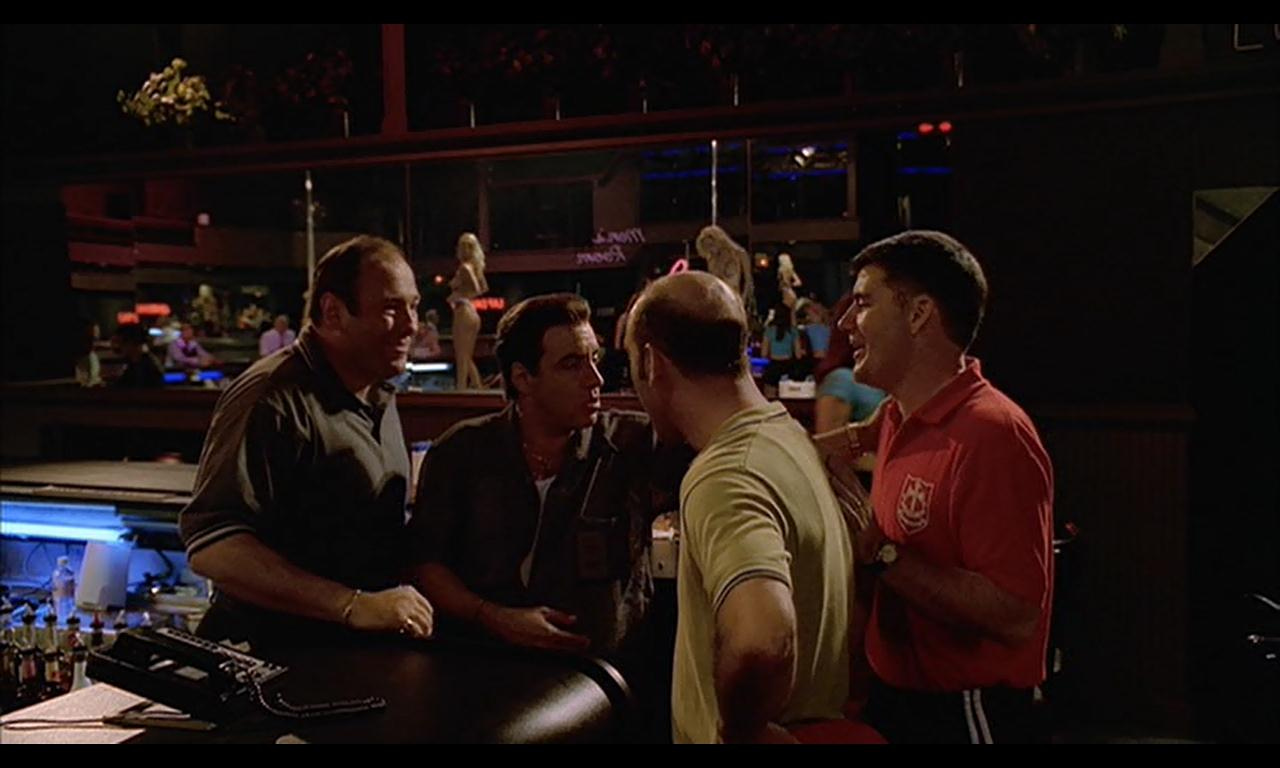
_Coach Hauser (right) with Tony and the boys in Bada Bing_
Hauser is visibly uncomfortable in the place, even more so when the prospect of a backroom “dance” is offered, so he makes his excuses and gets out of there.
The first inkling is that here we have two male extremes: on one hand the upstanding, law-abiding coach, inspiring his team to greater efforts and more success on the field, and on the other the organized crime bosses who embrace all the laws of the jungle and do whatever it takes — whatever it takes — to get their way, get ahead and stay ahead.
But soon we realize that all is not as simple as it seems.
It’s revealed that Coach Hauser has been having an affair with one of the girls on the team, a 16-year-old teammate of Meadow’s, and the mob’s plan turns from persuasion to punishment.
So those first two male extremes we’re presented with — the law-abiding and upstanding versus the gun-runners, the smugglers, the drug dealers and the murderers — are set aside and we get another extreme: the sexual predator.
---
Now you might ask: what has all this to do with self-worth and net worth, money and mindset?
And thanks for asking.
I am aware that there are both male and female readers here, and quite likely other readers on some other point elsewhere on the gender spectrum.
But no matter what your gender identity or sexual preferences, the reality is that how men show up in the world has a massive impact on the world all of us get to show up in.
If you are a man, how you show up — your state as you interface with the world — impacts all of the things that add up to the quality of your life.
If you’re not a man but you live with one, or near one, or work with or for one, the reality is that his state in his life will have a big bearing on the quality of yours.
And there’s no escaping this. We men, in general, are physically stronger, more volatile and take more risks, in everything we do.
So we can try to live in a world that doesn’t exist, or choose to learn about the one that does.
Human nature and human behavior is complex, deep, and full of terrible choices and the deepest, most inexplicable darkness.
There’s a strong argument that religion emerged in the first place as much out of a desperate human need to seek guidance from a higher power to overcome man’s most basic and most sordid instincts as it ever did out of religious or spiritual experiences.
We got new insights into man’s depraved, predatory hunger in a [high-profile recent court case in France](https://news.sky.com/story/gisele-pelicot-husband-destroyed-my-life-and-betrayed-me-says-woman-at-centre-of-mass-rape-trial-which-has-shocked-france-13239438), where 72-year-old Gisele Pelicot alleges that her husband — to whom she had been married for 50 years, with whom she shared three children and seven grandchildren, and who has already admitted to drugging and raping her — recruited dozens of men online over a nine-year period to come to their home and have sex with her drugged and comatose body.
We can read about a case like this and bless ourselves or give thanks that nothing of the sort could happen in our lives.
But could it?
Depraved and sordid behavior is everywhere. In my small town in Ireland, I’m familiar with at least five cases of family sexual abuse and rape — of women and children, boys and girls — that went on over decades. Some of it only emerged after the old guy died. Others came to light after decades of secrecy, leading to fresh hurt and family splits between those who wanted justice to be served and needed the abuser to be held to account and those who had pushed it deep down and wished it never to be spoken of again.
This is in my small town and its environs, population maybe 40,000.
Is my small town especially depraved, an outlier in criminal sordidness?
I don’t think it is.
---
So, again, Shane, answer the question: What has this got to do with anything I’ve been writing about here? What’s it got to do with our money or our psychology?
In a word: everything.
Who we are, how we are, what we do, our capacity to respect and value ourselves and the work we’re responsible for producing, our ability to live a good life where we can contribute to the whole while nurturing and protecting those closest to us — us men carry all of this. And we carry the other thing too: we carry a heavy, heavy weight, the possibility of abuse, violence, depravity, degeneracy and predatory behavior.
It is in us, somewhere, this capacity for a grave malfunctioning that destroys not only our own small individual life but destroys the lives of others, including the ones we were most responsible for, the ones we thought we loved the most.
It must be in us. If it were not, men would never do such things. Aleksandr Solzhenitsyn, the great Russian writer of the Soviet 20th century, knew that it was in us. In _The Gulag Archipelago_, he wrote:
> “The line separating good and evil passes not through states, nor between classes, nor between political parties either — but right through every human heart.”
---
One of the instincts almost every man I know feels — and, depending on your place in society, you might argue that this is 100% correct and right, or 100% a dire and damaging social construct — is a responsibility to provide for and protect those who need to be provided for and protected.
To do that providing and protecting, every man must walk the line.
On either side of that line, glaring at him and blaring at him, are shadowy opportunities, destructive temptations, illicit distractions and all the darkest recesses of the human psyche.
The only way to avoid a view of those pitfalls is never to take a step forward.
But you cannot avoid stepping forward.
To have a productive, fruitful, fulfilling and accomplished life, you must step forward.
Therefore few lives escape all of those pitfalls.
The very best of men stumble, fall to the dirt, scuff their knees, bloody their palms and hurt those closest to them, but still manage to pick themselves up, often by accepting a strong helping hand from someone further down the line.
The worst of us fall off the path, go tumbling into the abyss and never get out.
Tony Soprano was no role model, but Don Hauser’s is the life all men fear.
#The point of pain#
_Pain is the main driving force for action, but often when the pain stops, so does the action. How might we remember pain for greater action? Or is there a better question to ask?_
---
My wife, amongst other women, often jokes that until I am able to push a large watermelon out of my ass, or some other approximation of childbirth, I cannot truly know what real physical pain is.
She, and they, are right, of course.
I, nor any many, literally cannot imagine the pain of childbirth
It appears, on the outside, to be so ridiculously grievous, in a way so obscene, that you can’t help wondering why on earth any woman would ever choose to do it again.
But some woman do choose to do it again — some women choose to do it again and again — and they do so not just because their precious, miraculous newborn is worth it.
**They do so because pain has no memory.**
We might remember something of a _feeling_, even if it’s just a spectral shadow of the real feeling.
Times of great fear, moments of courage, the rush of jealousy and fleeting episodes of a host of other emotions all leave some stamp on our psyche. We can, if we just compel our minds to do it, recall something of great confidence even when our morale is at a low ebb.
We can be inflicted by trauma, and have that trauma rise up again at an innocuous trigger — a loud bang, say, or an unwelcome hand on a shoulder —but trauma is the debilitating and often recurring effect of the extreme emotions of painful moments, especially psychologically painful moments.
Trauma is the recurring emotions, not the recurring pain.
But pain itself, the acute physical manifestation, leaves no trace of memory.
---
> “Within ten minutes, the pain was gone and I was overcome with what I can only describe as pure and unconditional love…”
---
When we feel pain, we are driven to immediate and imperative action to bring that pain to an end, to get rid of it.
The more acute the pain, the more violent the action.
This is, I think, a big part of the reason suicide seems so inexplicable to those left behind. It’s not just that those left behind don’t understand how a mind might act in this way. It’s because they — we — have never experienced what it is that pre-empts suicide: a wholly final and unbearable pain at the very center of one’s being.

Suicide is the total, irreversible and complete response against an extreme and all-engrossing pain.
Over the past few years I’ve had the opportunity to experience extreme pain.
The pain has, thankfully, been extreme in the acute and physical variety rather than the acute and psychological one which can bring on thoughts of suicide.
A little over two years ago I ended up in the Accident & Emergency unit one morning, so great was the pain inside my head.
It was a pain that had me on all fours on my bedroom floor, pressing my head into the carpet to try to get to the unreachable itch — itch times a thousand — that seemed to have its epicenter three inches inside my skull.
That time, the nurses, noticing my inability to take my hand away from my head, found me a bed and hooked me up to the most beautiful mobile drip unit I’ve ever met.
**Whatever was in that thing, it added up to bliss.**
Within ten minutes, the pain was gone and I was overcome with what I can only describe as pure and unconditional love — love for whatever drug was dropping slowly into my vein; love for the people I’d never met and never would in some far-off pharmaceutical lab who had perfected the dose of this particular combination of enzymes, molecules and elements that was coursing through my body and making the pain go away and replacing it with bliss; love, pure love, for the nurse who’d wheeled the cart beside my bed and found the vein and walked to and fro for the next few hours, always purposeful, never rushing and looking for all the world like an angel come down from heaven and dressed in blue scrubs.
I recalled this moment again recently when that pain returned, a few inches lower in my head this time, behind my jaw and gums and cheek, a toothache that seems to be in all your teeth at once and in the bones above and below your teeth too.
It was a pain that required constant nursing with the heel of my hand pushed against my cheekbone, a pain which responded not at all to over-the-counter tablets, was partially numbed by several hot whiskeys laced with sugar and spices, and was dulled, thankfully if temporarily, by the heavy duty codeine painkillers I got after standing before a pharmacist and razzle-dazzling them with a sales pitch on the nature of my pain to make them consent to a two-day supply.
But the truth is, when the pain goes, it leaves no memory and only a trace of the feeling.
I only recalled something of the two-years-ago episode of carpet-nuzzling, skull-clutching and ER-visiting when the pain returned.
During this most recent episode, I was able to empathize fully with those faceless millions in America who became victims of the opioid epidemic.
There’s a scene in the recent Netflix series Painkiller where one of the main characters, a young man with a wife and family, owner of a vehicle workshop nursing an obscene level of pain following a forklift accident at work, pulls apart his whole kitchen in search of a single OxyContin tablet that would make the pain go away, even for a while.
When I saw that scene, the drama resonated, but I could never have felt his pain.
I know something of it now, but I also know that every day that passes, that memory will recede until it’s gone.
Pain drives action.
Pain renders everything else completely unimportant.
Pain carries a host of signals that compels us on the correct course of action.
I would do anything to get rid of this pain.
But when it’s gone, I forget. Everyone does.
---
**As great pain begets the greatest action,** solving for pain is a central hallmark of much of the best work and many of the greatest businesses too.
We might think we’re driven to seek pleasure or joy or happiness, but on the whole, people desire relief from pain much more than all that.
We might want pleasure, joy or happiness, but when we’re in pain, getting rid of that pain is a need of the highest order, and needs rule over all wants.
It is in this between-space where work and business tries to insert itself.
It’s why business consultants talk of “pain points”, and why sales directors try to find the exact person who has both the purse-strings and the pain.
Because nothing drives action more than pain.
Big problems create big pains. Big pains lead to big decisions and big actions.
(These life and business experiences, plus my own recent skirmishes with physical pain, made me empathize a little more — and I know this might sound crazy — with some of the people within the pharma companies behind the American painkiller/opioid crisis. Yes, the executives covered up the data that showed the addictiveness of those drugs; yes, they were driven much more by the lure of profit than the satisfaction of doing good; and yes, they deserve all the punishment they get. But none of us is either all good or all evil, and many of the people within those pharma businesses, the people who produced and promoted and pushed those drugs, will no doubt have witnessed the relief from pain the product brought, and from there were motivated to get the tablets into more people’s hands.)
So if it’s true that great action creates great results, and great pain prompts great action, and that pain has no memory, it presents us with a conundrum.
Our action will slow down and eventually stop when the pain runs out.
Which gives rise to a question:
**How might we remember the pain so that we can keep taking the necessary action?**
But maybe this is the wrong question.
Maybe there are other, better, questions to ask.
Such as:
* If great pain creates great action, how might we routinely expose ourselves to the sort of pain that keeps us taking big steps forward?
* How might we make an enemy of comfort and accept pain as an unavoidable ingredient in a great life?
* Given that pain is so central to the beginning of life, and so often so central to dying and death as life drops away, what if pain — and the capacity to deal with and work through pain, and the ability to ease the suffering that comes with pain — is actually the point of life?
Thanks for reading.
Till next time.
#Shared narratives#
_Without a shared narrative of the past, we don’t know how we got here. Without one of the present, we don’t know where here is._
---
Without a shared narrative of the past, we don’t know how we got here.
Without a shared narrative in the present, we don’t know where here is.
A shared narrative is everything from a water cooler conversation about last night’s episode of The Sopranos to general agreement about what happened in concentration camps in World War II.
A shared narrative creates a feeling of belonging in time and in place, a sense that the past made sense, the present is ripe for the picking and the future will open out in one of a small handful of possibilities.
A shared narrative meant a sure footing on solid ground, two things we’ve needed since we told stories around fires in caves.
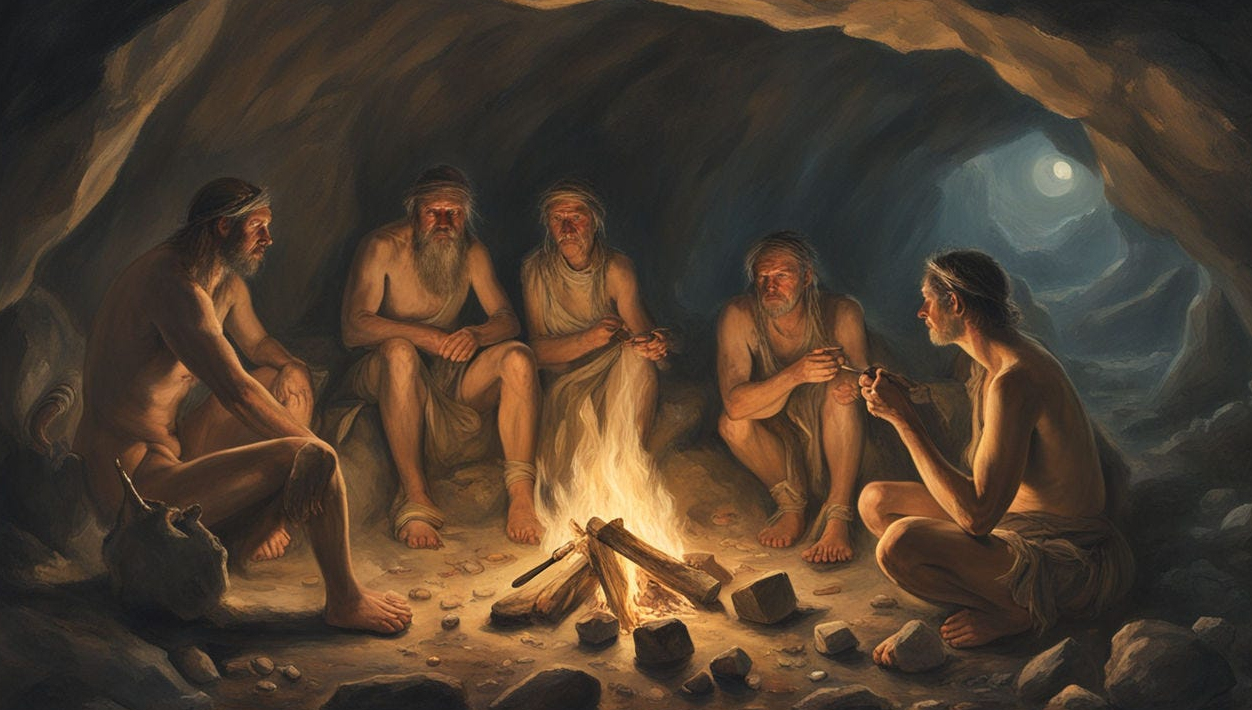
_Image via [AI Hybrid / Deviant Art](https://www.deviantart.com/aihybrid/art/So-Eat-What-We-Hunt-Alive-Together-We-Can-Stay-986751593)_
Our shared narratives, and all shared narratives, are gone and gone forever.
The past is revised and revisited and redefined over and over again, so much so that you doubt everything you used to know.
For just one of a million examples, you see rampant money-printing by government central banks and federal reserves, and then you see the out-of-control inflation you expected — because that day in history class in school years ago, when quantitative easing was discussed, you paid attention — but then you see the experts and advisers and television talking heads say that this inflation is “transitory”.
And you shake your head.
You shake your head in growing frustration and deepening rage, mad as hell at the narrative rug-pulling that’s going on to try to make you question your own eyes and ears and judgment.
Or maybe you shake your head just to try to clear it, because you think you must be imagining all this, because you think you must be asleep and this must be a bad dream, because you think that any day now the lunatics will be run out of the asylum by the adults who have come back to take control.
But you don’t wake up because you’re not imagining it — or is that what a 3D dream like this would make you think?
**So you don’t recognize the past you lived and learned about.**
There’s no escape in **the present** either, because the present is dissolute and scattered. Nothing you see is the same as what anyone else sees. Apart from the Super Bowl and Presidential election night and a handful of other hours-long moments every few years, we walk around every day with almost nothing in common with anyone else. There are people who are celebrities to you who 99.999% of other people could not pick out of a line-up.
The present is so dissolute and scattered that you look around and wonder just when did it happen that everyone went insane. And then you realize — with a mounting horror, with that terror that came when you were a schoolkid and the mob had gathered round you in the playground, when you knew what it felt like to be completely and absolutely without power — you realize that not only does _everyone around you look and act insane to you_, but that _you look and act every ounce as insane to them_.
Everyone looks and acts insane to everyone else, in a kaleidoscopic hall of mirrors that’s like a film made by Alfred Hitchcock and David Lynch and Yorgos Lanthimos, where the uncanny is so ever-present that in some odd way it tries to suggest that it is not uncanny, it is real.
Shared narratives started dissolving with the mainstreaming of the Internet two decades ago.
The Internet, and everything built on top of it — Bitcoin to Uber, Tinder to ChatGPT — is humanity’s vanishing point: the point in time when everything afterwards is all changed, changed utterly.
As I wrote in “The vanishing point”,
> “The opportunity is vast. All of us can build lasting relationships, create saleable items and get paid from anywhere in the world, with just an everyday computer and a decent Internet connection.
> The size of the opportunity is directly proportionate to the size of the imagination.”
Just because the opportunity is vast does not mean that the trapdoors are not deep and dark and present at every footstep.
The loss of shared narratives presents as big a challenge to our lives as the vastness of the possibilities presents unprecedented opportunity.
When no shared narratives remain, everything that was previously shared and agreed upon becomes a battleground staging a fresh fight.
Without shared narratives, we cannot get a foothold or a handgrip, and if we fall, the fall might last forever, tumbling into an infinity black hole where the only release is… what?
Death? Madness? Something worse than both?
And yet.
The pain of the vanishing point — much of it resulting in and rising from the death of all the shared narratives we once held — must hold a seed of rebirth.
This is the driftwood in the storm.
We cling to it because we must. It’s our only hope.
We have no idea what’s next.
Infinity both directions.
The downward pull of gravity is strong and our fingertips are screaming.
If we let go, what are the chances that we soar?
#The vanishing point#
_The digital opportunity is vast, but standing out from a billion-strong crowd requires you to do something essential and painful to leave the past behind._
---
To beat the drum again:
A long list of things you can do before getting out of bed — send an email, order an Uber, DM a model on Instagram — would have looked like black magic to your grandparents.
The opportunity is vast. All of us can build lasting relationships, create saleable items and get paid from anywhere in the world, with just an everyday computer and a decent Internet connection.
The size of the opportunity is directly proportionate to the size of the imagination.
Almost 100 years ago, Napoleon Hill wrote:
> “Whatever your mind can conceive and believe, it can achieve.”
Never in the past 100 years has that been more true than it is now.
The vastness of the opportunity is also directly proportionate to the vastness of the competition. Massive upside creates massive downside.
As a pessimist might say, “What goes up must come down.” Or as Simon Kuper, the Financial Times writer, put it during the fast-tracked work-from-home days of Covid-19: “I can do my job from anywhere, but that means anyone anywhere can do my job.”
In the new global marketplace, two things stand out:Intelligent ideas fleshed out courageously over time
Us-versus-them entrenched positionsThe wind in the sails of #1 is aspiration and ambition for a better future.
The oil in the engine of #2 is outrage and fear because the past is lost.
If you prefer camp #2, go right ahead. You’ll find lots of company there.
If you prefer the borderless digital tribe of #1, your next question should be:
**How?**
The how is two-fold:
1. Finding out what you can uniquely say.
2. Saying it. (Courageously. In different ways. Over and over again.)
Finding out is always hard, because it means leaving behind what you’ve become, and leaving behind what you’ve become is painful. It requires rebirth — you can’t remember the pain of being born, but you will always remember the pain of being reborn.
Let’s paint a picture.
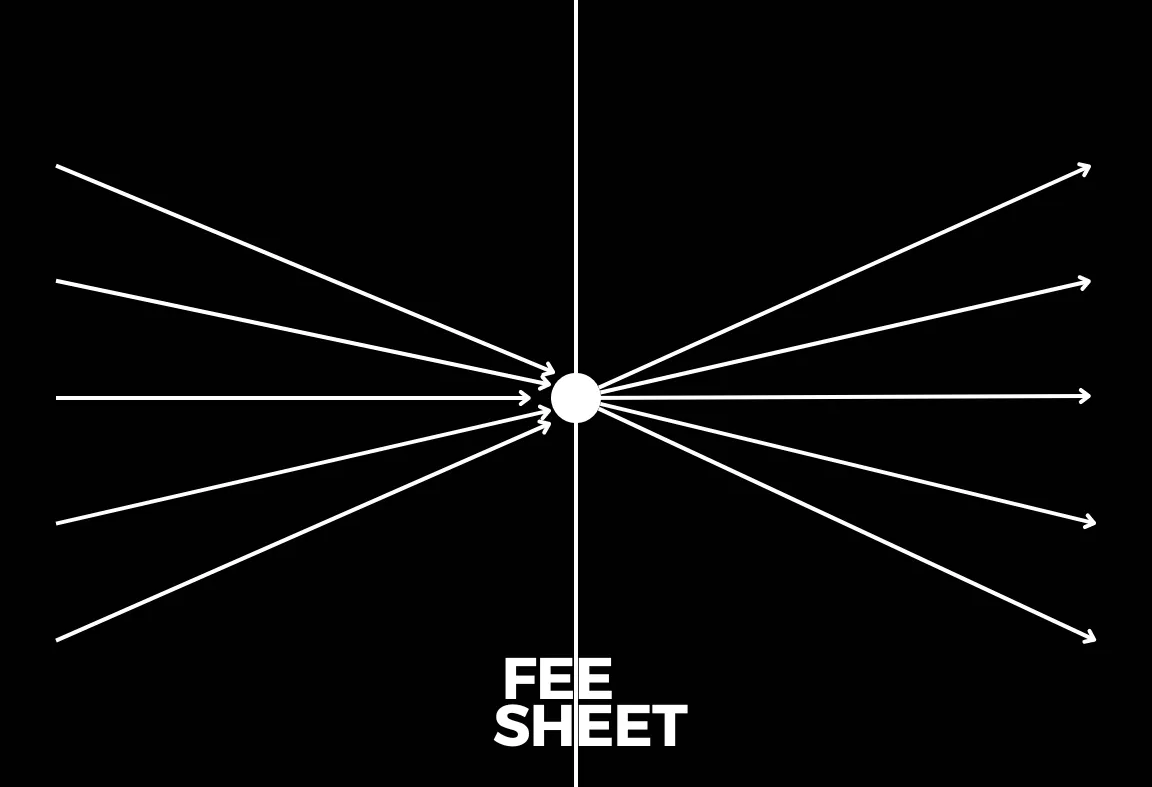
See that point in the middle?
That’s the place you need to get to.
It’s the “X marks the spot” of the buried treasure.
It’s the vanishing point of the old self and the expanding point of the new.
It’s also a place that’s out of reach for almost everyone.
It’s so far out of reach for most people in camp #1 (the “us-versus-them” crowd) that they don’t even know it’s there.
But even many aspirational, ambitious people have no idea how to get there.
They fire shot after shot after shot and they never come close to the place they need to find.
Their picture is more like this.
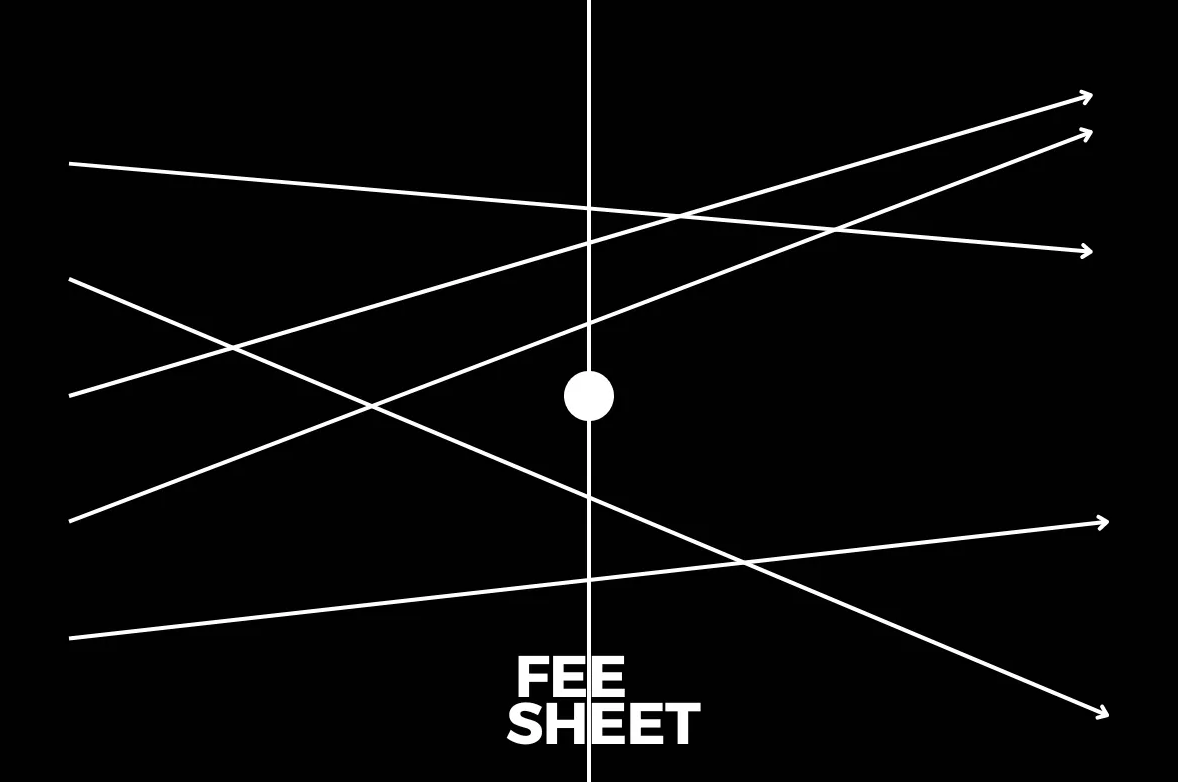
So what’s that point in the middle?
It’s different for everyone.
**That’s the point.**
It’s a collection of thoughts, ideas, concepts, beliefs, experiences and perspectives that make you uniquely you.
Because only by peeling back the layers to see who you uniquely are, and then fully inhabiting it, will you ever get to explore the potential that lies dormant within you.
Most of us spin wheels, expelling great energy but finding no forward motion.
We might post on X, send a hundred connection requests on LinkedIn, write on Substack and upload photos to Instagram. We listen to science and business and technology books on Audible. We have a Kindle full of skimmed samples.
We spend weeks preparing for a job interview nobody has asked us to attend, months working on a product nobody wants to use, years carving out a career nobody will miss when it’s done.
We find our way to work each morning hoping nobody finds us out.
All because we haven’t reached our vanishing and expanding point.
It’s the line in the sand.
It’s the major life crossroads.
It’s the time and place all our thoughts, ideas, concepts, beliefs, experiences and perspectives lead us to, where we must leave our old pupal state behind and shuffle off the cocoon, because what got us here will never get us there.
It’s the time and place where we can unfurl and expand and spread our wings and take a leap of faith and — eventually — soar, into the thing we were born to be, decades after we left the womb.
---
> “Every man has two lives. The second begins when he realizes he has just one.”
---
#Other people#
_Is this the meaning of life?_
---
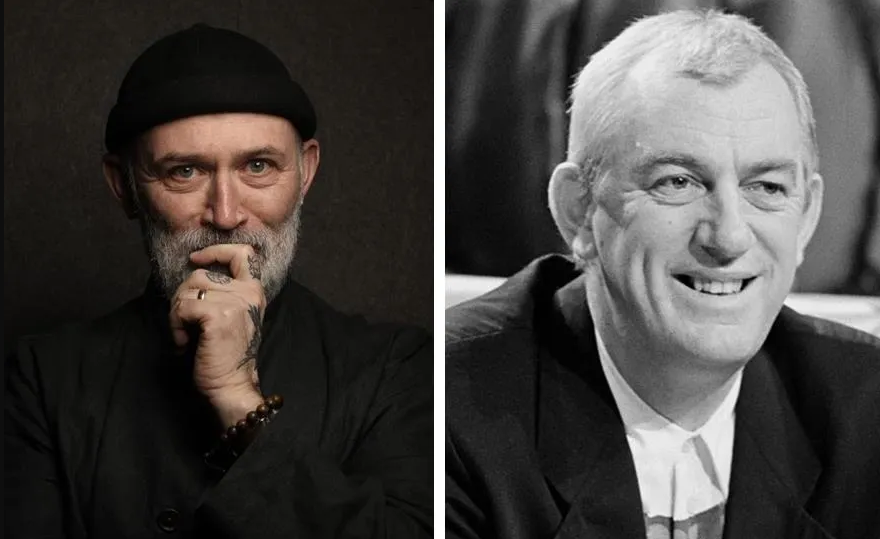
_Tommy Tiernan (left) and Shay Healy_
It’s strange to write this, because maybe half the people reading this are Irish and know exactly who I’m talking about, and half are not and have no idea, but Tommy Tiernan is an Irish comedian and Shay Healy was an Irish broadcaster, songwriter, journalist and entertainer.
Tiernan rubs many people up the wrong way. His shows routinely run right up to the line of controversy or go sprinting past it. In his defence, and in defence of all comedians everywhere, comedy is about much more than making people laugh. Comedy is about making people laugh about things that are vital in our civilization. By laughing — even involuntarily, even as we might be tempted to look around to see if anyone has seen us laugh — we are forcibly considering and reconsidering things essential about the way we live, or things essential to confront and change if we’re to go on living the way we’d like to.
While Tiernan continues to go strong — recently he made a [well-received appearance on the podcast of American comic Bill Burr](https://www.youtube.com/watch?v=H47ZbiiKCQY) which threatens to bring him to a whole new audience — Healy died in 2021 at the edge of 78. He had also courted controversy during his working life, especially with his late night Irish television show _Nighthawks_, filmed through a haze of smoke and with cans of booze strewn everywhere and offering up a rebellious, almost anti-establishment voice — which, coming through the screens of the state-funded national broadcaster, was quite an achievement.
The reason I bring up both men here now is a story that came back to mind from somewhere over the past couple of days.
It was a story Tiernan told on his own podcast, either after Healy died or during his well-publicized late life struggles with the cancer that would eventually take him away.
Tiernan recalled being in a room with the ailing Healy at some awards ceremony or other, and the broadcaster, seated at a table and without much of his old strength left, beckoned to the comedian. He went over to meet him and leaned in, sensing that he wanted to impart something important. Whether it was the man’s sickness or the noise of the room, Tiernan struggled to take in the message being spoken, and leaned in further, fully sure now somehow, through the demeanor and body language of the seated man, that it would be profound, even vital.
The words he heard were, or approximated:
> “Other people. Everything. It’s about other people.”
---
In our desperation to make a fortune or even just a living, in our tireless attempts to carve out a slice of the life that resembles even slightly the wishes for ourselves that we harbor within our minds, it is too easy too often to lose sight of the people we meet along the way.
For a few of us, those who occupy the further end of the narcissistic/sociopathic spectrum, other people are nothing more than just a means to our end.
Most of us might not drift too far along that spectrum but, if we’re truly honest with ourselves, we do spend some time there. We go through our days seeing servers behind coffee counters or drivers behind wheels without noticing anything about who those people truly are.
Worse, our drift towards narcissism picks up speed via our hyperconnected lives. More and more people are now just usernames on screens. All we see or care about is the handful of words or emojis that appear next to them.
In failing to see ourselves in one another, we come to distrust and fear one another. Groupthink and endless labelling makes this worse. We see other people not as human beings, each one the same as us and yet wholly and beautifully different in their individual uniqueness, but as members of a race, a nation, a team, a tribe or an oppressed victim group in an endless 4D pyramid game where everyone is either oppressor or oppressed and often both at the same time.
How can we see ourselves in one another when we come to distrust everything we see?
How can we build connection with those around us when we silently but routinely send a message that the anonymous username on our screens is more important than the real live person standing right in front of us?
Those two words, “other people”, quietly voiced by one entertainer to another, force us to look at the world afresh.
They force us to face the truth that while we might stand tall and straighten our backs and prepare ourselves for whatever violence or opposition the world throws at us — and all of that is good and necessary — we are nothing if we allow the ties that bind us to be torn apart in every direction.
We are in danger. We’re in danger of being split into eight billion individual nodes, all fearful and distrustful of all the other nodes.
Our wealth and our wellbeing is influenced by other people. The money in our bank accounts, every cent of it, passed through the bank accounts of other people first.
Think for a moment.
Recall a time when you felt great joy or peace or satisfaction. Were you alone? Or were you with other people?
What about love or beauty? Is it ever possible to truly experience love or beauty without sharing it with or experiencing it through others? In the greatest possible way, love and beauty is a shared experience with humanity itself, and the “other people” is everyone, all connected by some divine thread.
Beneath all of our goals in life lie the greater underlying goals of happiness, joy or peace.
Money is often oxygen on the road to these goals, but money can only be a conduit rather than the thing itself.
All the way back in 1815, William Wordsworth wrote:
> Surprised by joy — impatient as the Wind
> I turned to share the transport — Oh! with whom
> But Thee, long buried in the silent Tomb
Wordsworth knew that any joy he felt paled quickly when he was unable to share it with his loved one.
A century of psychoanalytics and countless therapy sessions have created our direfully self-reflective times.
Self-knowledge and self-awareness are vital.
Self-occupation, though, when it comes at the expense of everyone else in our lives, paves a lonely, tortured, torturous path.
I’ve been around the world. I’ve seen many sunsets and heard many songs. And let me tell you there is nothing in this world — nothing — more beautiful than the light reflected in another human being’s eyes.
#Finding your voice#
_Three minutes about one of the most urgent responsibilities of your life._
---
> “Most men lead lives of quiet desperation and go to the grave with their song still in them.” — Henry David Thoreau
---
James Earl Jones, maybe the world's most famous voice, has died.
He voiced two of the most iconic parts in movie history — Darth Vader in _Star Wars_ and Mufasa, father of Simba in _The Lion King_.
It might have been different.
He landed the part in Star Wars in 1977, when he was an actor already approaching 50, with a decent resumé on stage and screen but zero star attraction. Later, he recalled that the movie’s director, George Lucas, could easily have gone in a different direction.
> “The rumor is that he thought of Orson Welles. And then probably thought that Orson might be too recognizable.”
James Earl Jones’s voice feels almost eternal now, nearly half a century later, with the words and tone of characters like Darth Vader and Mufasa forever available to our inner ear, but it did not come out fully formed. It took decades to become what it eventually became.
He said:
> “[Lucas] ends up picking a voice that was born in Mississippi, raised in Michigan, and was a stutterer. And, that happened to be my voice.”
---
Few of us will ever get to have a “voice” as recognizable as that of James Earl Jones.
But that doesn’t matter. Because your voice is every bit as distinctive and vital to your life as Jones’s was to his.
Your voice — the one that might still be forming inside your body, waiting for the day that it emerges — is your representation of how you do anything.
It’s not just about writing, or speaking, or singing. It’s all of those and more. It’s two things together. It’s who you are as you express yourself to the world. It’s where the inner you and the outer you meet in harmony.
**So if your voice as vital to your life, how do you go about finding it?**
The writer and poet Larry Woiwode, who died in 2022 at the age of 80, taught classes of aspiring writers about the subject of voice. It had taken Woiwode many years to find his own voice, and then he spent many more teaching what he’d learnt to others.
He once [wrote of that journey to finding his own voice](https://theamericanscholar.org/finding-your-voice/), which involved years of reading his work aloud, to his girlfriend-then-wife but also to his own ear.
In the past, he said, often advice to writers had been about creating a persona or developing a style, and that this act of creating and developing was what brought about the “voice”.
But, Woiwode said, finding one’s voice was much less about constructing a ***style*** and much more about uncovering a ***truth***.
He wrote:
> “I was troubled at times by encouragers who said about a future moment I feared, an interview or public performance, ‘Just be yourself.’ I wasn’t sure who that was.”
As he scraped away at the dust covering “who that was”, he found that:
> “At the center of any credible truth is an individual voice as identifiable as a fingerprint.”
He also found — and this might be even more relevant now, in our technologically interconnected age, than ever before in history — that finding his own voice and bringing it to the surface did not necessarily make things any easier. He might have found and embraced the truth and expressed it in his own unique voice, but he also discovered that that truth was often hard for others to hear.
> “The clearer my voice became, the more my work met resistance.”
This, then, the task of finding your voice and bringing it to the world, is both a principal challenge and principal responsibility of your life.
And you must face this challenge and take on this responsibility with some urgency. Your whole life demands it.
There are some who would say that this whole topic is vain and egotistical.
But do not mistake the desire to find your voice as ego.
It is not ego to bring your unique and truthful voice to the world.
It is the ego that covers it up in style and embellishment and falsehood.
Because let’s face it. If we’re truly honest with ourselves, none of us want to approach the end with our song, as Thoreau said, still buried within us and bound for the grave.
#The days of our lives#
_When we look backwards and think of what we remember, we know that all days in the past were not equal. But is this really true?_
---
_The sun always rises. (Photo by [Marc Kleen on Unsplash](https://unsplash.com/@marckleen))_
---
Memory is endlessly fascinating.
I’ve written before about money memories, and how they form. But never mind the specifics of money for a moment and just consider memory more broadly.
Think of when you were five years old, or 10, or 20. What do you remember?
We don’t remember whole scenes or occasions. We don’t remember complete events. We don’t remember the start to finish of anything, even days that we might think of as vital days that made us who we are right now, today.
Instead we remember slivers of things. Moments. Flashes.
My first memory is of the football World Cup in 1982. All I remember is color. My mind tells me now that it was Brazil vs Italy, but I have no way of knowing whether that’s just a story I’d like to believe (the Brazil-Italy game of 1982 being an all-time classic). But I do remember color: the green of the pitch, the yellow and blue of the jerseys — or is that just my Brazil-Italy wishful thinking? I think I remember the noise too, of the commentary coming through over crackling airwaves, of the fans in the stands, but none of the specifics are available to me.
Later, I remember walking up the wooden steps of the school on my first day there when I was four. I presume my mother was holding my hand, but I have no memory of that. It’s just a photograph, but one without any details. It’s not even clear enough to be grainy. I remember another moment, eight years later, on the last days in the same primary school, and a boy — I don’t remember who, even thought it must have been someone I’d shared a classroom with for years — singing “We’ll be out of this kip on Tuesday! Out of this kip on Tuesday!”
_(“Kip”, in Irish colloquial slang, means a “dump”.)_
I remember lying in a sleeping bag on a mattress on a floor in a Dublin house, beside my first serious girlfriend somewhere around the day we broke up. I was about 21. I don’t remember anything else. (I remember that I remembered her 10-digit phone number for years afterwards, and as I think now, those ten digits again hover into view.)
I remember the first moment I locked eyes with my wife. I know love at first sight exists, because my life has been governed by one split second moment for more than 20 years now.
I remember holding my daughter on the day she was born. I remember, three years later, the morning my son was born, but I hate the fact that I don’t remember holding him. He was born at 5.30am on a Monday and what I remember from that morning, of all things, is that throughout my wife’s short few hours of labor a tiny TV in the corner of the ward was silently showing a live American football NFL game.
There are countless days I don’t remember.
I say all this just to remind myself, and perhaps you too, that all days in our memory are not equal.
And even more importantly, to remind myself that if all the days in the past were not equal, then of course all the days of the future — including every present moment we will ever have — will not be equal either.
We always feel in the present moment, even if we don’t have the language, the mental acuity or the emotional maturity to pinpoint that feeling.
We can also remember something about how we felt. How we felt in those past present moments is a key ingredient in the memories that remain available to us now.
How might we use this knowledge — the knowledge that we feel in the present moment, and that how we felt in past present moments greatly influence the quality of our memories — to show up differently in our future present moments?
If it’s possible to remind yourself about the future — and I think it is, because that’s the entire premise for this essay — perhaps the most important reminder we must bring to the surface, and keep close at hand, is this:
The present moments we experience in the future will come and go. If we are lucky, they will bring both great joy and great difficulty. The great difficulty will be intricately intertwined with the great joy. It’s impossible to experience great joy without experiencing great difficulty, because it’s the difficulty that gives meaning to the joy. What matters most is that we do the necessary work within our minds: first, to acknowledge the difficult days when they come and do what we can to limit their influence, to stem their flow; and second, to fully appreciate the joyful ones when they come.
We _know_ that all days in the past were not equal.
So we must _know_ that all days in the future will not be equal.
This should give us solace and encouragement for difficult days, and for the slow and boring ones too, because all those days are just another step on the way to the days that will bring true joy, peace and the new memories we will want to take forward for the rest of our lives.
---
But, a small counterpoint.
(The physicist Nils Bohr said, “the opposite of a profound truth is another profound truth”. With every piece I write I’m aiming to get as close to truth as possible. Whether any of the truths I happen upon amount to anything profound is not for me to say.)
Just because all days in the past were not equal, and because we know that all days in the future will not be equal, doesn’t mean that all days — even the nondescript ones — are not important.
The days I don’t remember also formed me and carved out the life I have now just as much as those I do. They must have done. It was their quality of _forgettable-ness_ that was formative. They were formative in good ways — skills slowly built up, work steadily done, relationships cultivated over years and decades. And they were formative in bad ways too. I’m not sure anybody enjoys the process of reflecting on the pattern of bad days, bad decisions, opportunities allowed to slip past, relationships allowed to go distant or fester, all of which which together add up to an outcome you have now and do not want.
It is necessary, though, to reflect on our own agency on our good days and bad ones. As Jerry Colonna, the soft-spoken but steely leadership coach and author I was lucky enough to chat with on Zoom during the pandemic, puts it:
> “How am I complicit in creating the circumstances I say I don’t want?”
That complicity lies in all the forgettable days of the past.
That complicity will also come in all the forgettable, difficult or just boring days of the future.
What we do on the forgettable, difficult and boring days cultivates the life we will have years or decades from now.
Thinking in seasons might help. There are always ups and downs. There is always decay, death, rebirth and regrowth, and not just in organic matter. And because we know there’s always decay-death-rebirth-regrowth, we must know that all the difficult days are necessary ones in that cycle.
It’s true that all we ever really have is this moment, today, and how we choose to experience it.
It’s true also that all those individual todays, forgettable or stirring, eventually pale into insignificance and the longer timeframe of the collective is what creates our present reality.
To remind me of everything I’ve tried to work through here, this visual, by digital entrepreneur and visual designer [Jack Butcher](https://x.com/visualizevalue/status/1385067484554858497), of an idea by [Carl Richards (aka Behavior Gap)](https://x.com/behaviorgap), has been my screensaver for years.
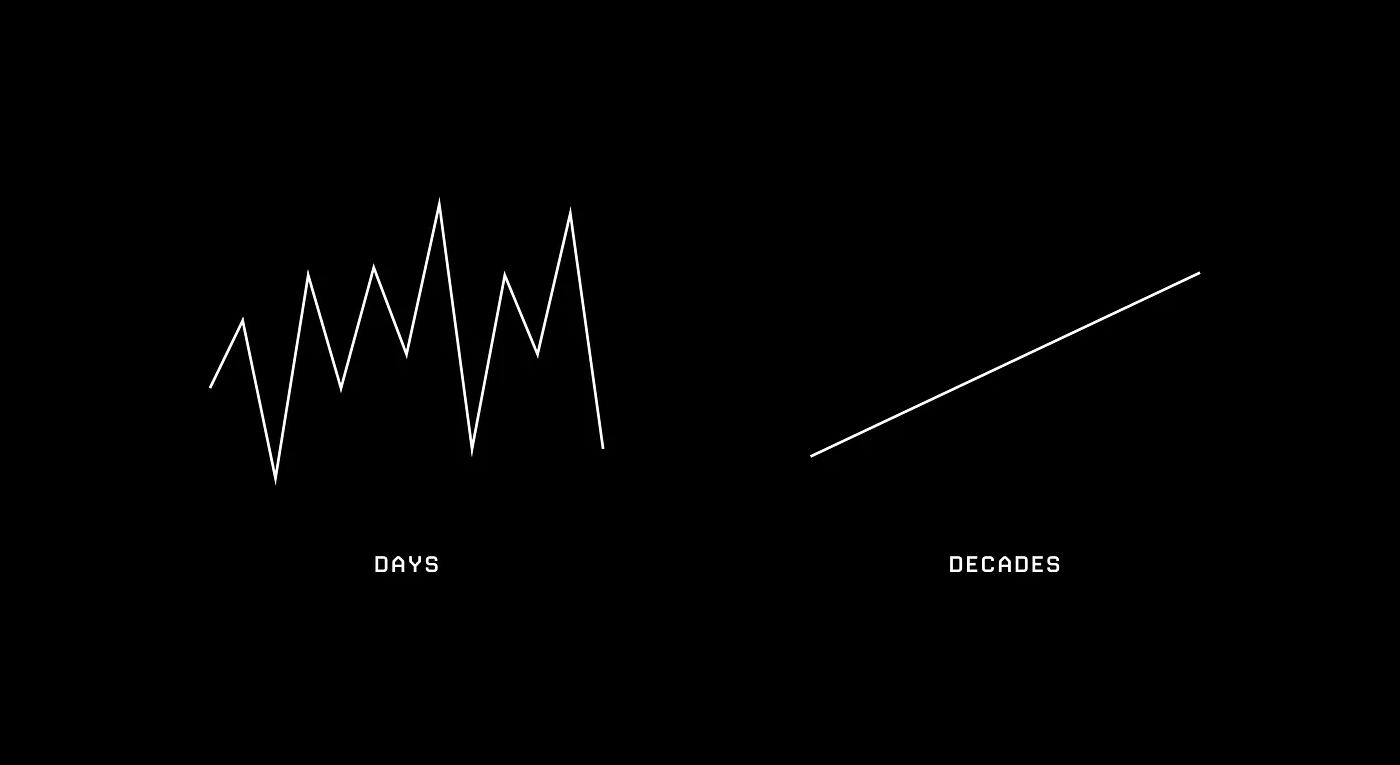
Thanks for reading.
#Money memories (and how they form)#
_A short essay on the way emotions and memories can infuse together to influence behaviors and attitudes for decades._
---
_“Your memory is a monster; you forget — it doesn’t. It simply files things away. It keeps things for you, or hides things from you — and summons them to your recall with a will of its own. You think you have a memory; but it has you!”_
— _A Prayer for Owen Meany_, by John Irving
---
While I was working on one of this week’s episodes for my [Poems for the Speed of Life podcast](https://open.spotify.com/show/15wJ71x4MHqQZH7YucOlvD) I had a small realization about the way memory works.
The poem was “Weakness” by Alden Nowlan about a moment, presumably when Nowlan was a boy, when he witnessed his father preparing a sick horse to be euthanized.
I won’t expand here on the specifics of the poem itself, or the teaching it might offer (if that’s something you’re interested in, you’re very welcome to check out the podcast ([Spotify](https://open.spotify.com/show/15wJ71x4MHqQZH7YucOlvD) / [Apple](https://podcasts.apple.com/ie/podcast/poems-for-the-speed-of-life/id1659857076) / [Substack](https://poemsforthespeedoflife.substack.com/)); the current series is on the theme of “Fatherhood”).
What did present itself in the reading, though, was something about the way memory works. Poetry often works like this. Memory, in many ways, is the essence of poetry — the fragility of memory, its tenuousness, its power to bring tears to the eyes years or decades later, or to wreak havoc in the present moment by resurfacing a traumatic experience from long ago.
The important thing is not just the memory.
The important things is the emotions attached to the memory.
So when I then read the paragraph that started this piece from John Irving’s 1989 novel _A Prayer for Owen Meany_ it double-underlined this new knowledge of the way memory works.
Memories of money — memories of money infused with emotion, and typically a very negative form of emotion: guilt, shame, envy, anger or fear — often form the bedrock of our relationship with money.
In the interviews I’ve been working on, memory has been a recurring topic of conversation.
Josh Forti, recalling his childhood in rural USA, said that “money was certainly one of the areas that [my family] struggled to understand. My relationship with money growing up was that every decision revolved around money, and mostly the lack of it.”
Remembering her childhood in Scotland, Eloise Leeson-Smith said, “My father never ever, ever told us his salary. And I never asked ... In terms of how we talked about money as a family, I think it was probably something our parents didn’t want us to be overly aware of … [Money] was never taken for granted. It was never assumed that you'd always have it … We always valued spending time together, and money was a way for us to spend that time together. “
In other interviews to come in the next few weeks, I hear from bright and successful entrepreneurs on their own formative experiences and money memories, including one whose hugely successful father gambled most of his money away, leading to an acrimonious separation and the traumatic memories of watching her newly single mother try to make ends meet, leading to situations where “no one talked about money — like, no one talked about it! It was all a secret.”
---
There’s no _how_ here. There’s just _what_.
This is the _what_: the often tiny moments that are forgettable to all but you, and — weirdly — forgettable even to most of your conscious mind but molded forever on your psyche.
This is the what: that these tiny moments, the emotions they create and the way those emotions (and the situation that caused those emotions) are lodged in the deepest recesses of your mind, might unconsciously influence — even control — your behaviors and attitudes even many decades later.
This is also the _what_: that changing these behaviors and attitudes, wrought over years by the unconscious workings of your mind, might be the single biggest lever you can pull to positively influence the rest of your life and the lives of those you care most about.
You might ask, there must be a _how_?
I have no certainty about that.
The only certainty might be that whatever the _how_ of changing this is, it’s very likely to be a different how for you, for me and for anyone else reading these words who feels like they’ve got some behaviors and attitudes they’d like to change, especially around money and the way they think about it.
It’s also, almost certainly, something that might take a few months or a few years to work through.
Thanks for reading.
Essays on sports
#What the Paris Olympics can teach us about the world#
_For months after the 2024 Olympics, I wasn't able to get it out of my mind. This essay is my attempt to explain why._
---
There’s a great TS Eliot poem of the early 20th century, [“The Love Song of J. Alfred Prufrock”](https://www.poetryfoundation.org/poetrymagazine/poems/44212/the-love-song-of-j-alfred-prufrock).
The poem’s original title was “Prufrock Among the Women”, which hints at its subject matter — a poem about an ordinary everyday failure of a man and the incessant chatter of his innermost desires unrealized and lingering regrets for all the opportunities missed.
It is an extraordinary poem, not least because TS Eliot was just 21 when he wrote it. (In that way, it’s a bit like Jackson Browne’s song “These Days”, a song which deals with the regrets of life and love — _“These days I seem to think a lot / About the things that I forgot to do for you / And all the times I had the chance to / And I had a lover / But it's so hard to risk another, these days”_. When he wrote the song in 1964, Browne was 16.)
As poems go, Prufrock is not exactly an easy read, but like the best works of art, it has layers and depths that reward you each time you return to it. There’s one line in there that’s come back to mind repeatedly over the past couple of months.
> “I measured out my life in coffee cups.”
I, for decades, have measured out my own ordinary life and its own ordinary failures in four-year Olympic cycles.
Indulge me.
***Seoul in 1988:*** Sitting with my family — us children all still children, parents still together and still happy enough, or so it seemed, even just a few years before the cataclysm of marital and family separation. I remember watching the final of the men’s 100 meters, gazing in awe as Ben Johnson, the Canadian sprinter, muscles and yellowing eyeballs bulging, punched the air while breaking the world record in 9.79 seconds. I recall the news a day or two later, scandal breaking as Johnson was found to have steroids in his system. (That race in Korea is now widely seen as [the dirtiest ever run](https://www.amazon.com/Dirtiest-Race-History-Johnson-Olympic/dp/1408158760).)
***Barcelona 1992:*** My family splitting apart at the seams, the final few weeks in the house that was our home since we were born, [Freddie Mercury singing the city’s name](https://www.youtube.com/watch?v=7icIbZYvEtk) and the [Olympic flame lit by flaming arrow](https://www.youtube.com/watch?v=gmRf41SVHS4). That home was an idyll of a small house in the country beside a farm field with a small pond in the corner where I must have knelt for days on end, because I remember how a gluey mass of frogspawn one day erupted into a shoal of swimming tadpoles the next.
There was no room for frogspawn in my father’s new house, a semi-detached in a housing estate in the town. There, the laddish chatter on street corners and in unfamiliar sitting rooms was played out against a soundtrack of Red Hot Chili Peppers music: their album _Blood Sugar Sex Magik_ was fresh and new, MTV had brought “Give It Away” and “Under The Bridge” into our consciousness, and Chubby Lee was the coolest boy I’d ever known or ever would, who carried a ghetto-blaster to the green in the middle of the estate and who five years later would be dead, one of three friends killed in a car accident before he could ever become a man.
That summer of 1992 was all American: the Chili Peppers, MTV and basketball. All the young teenage boys who lived in the estate talked about the “Dream Team”, the US basketball superstars of the NBA — Michael Jordan, Magic Johnson, Scottie Pippen, athletic giants of black men unlike anything anyone had ever seen around our small Irish town — who had come to Barcelona, a sort of exhibition team putting amateurs from around the world to the sword on their way to the gold medal.
That summer was _almost _all American.
---
That same month, a big part of 14-year-old me fell in love with a 17-year-old Hungarian swimmer called Krisztina Egerszegi, each one of her three golds in the pool bringing a smile that melted the heart of this Irish boy a thousand miles away.
_Krisztina Egerszegi_
***Atlanta 1996:*** Michael Johnson breaking the 200m world record, and Ireland’s Michelle Smith winning three swimming gold medals amid suspicions that she wasn’t doing so entirely clean. As I started out in college, drawn both by the athletic accomplishments and corruptions and the people who wrote about both so compellingly, I set myself the goal of working as a sports journalist at the Sydney games four years later. I did not make it to Sydney to see Ian Thorpe in the pool or Cathy Freeman in the hood. Instead, working my first journalism job — for a small magazine press, operating several leagues below the writers I looked up to — I went with a crowd of colleagues to a local pub at breakfast time to see Gabriela Szabo beat Ireland’s great hope Sonia O’Sullivan in the 5000m final.
---
I have unforgettable memories of so many Olympic Games, but somewhere along the way real life seemed to intervene and the romance of it all died or was hoovered up. London 2012 was a momentary beacon, sweeping up even us Irish in a long list of Great Britain’s great Britons — Jessica Ennis, Mo Farah, Chris Hoy, Andy Murray — and in the boxer Katie Taylor bringing us a hero of our own. I remember, this above all, bottle-feeding my then nine-month-old son to sleep, still reeling from the new reality of fatherhood. Rio in 2016 is a black hole in my mind, coming the same summer that my life came off the rails. For Tokyo in 2021, the Covid games played out like a horror movie in front of empty stands and deserted streets, I was on holiday elsewhere and scarcely gave it a passing thought.
So if you’d have asked me a few months ago whether I was looking forward to the Paris Olympics, I would have been lukewarm. I’d watch it, probably, whichever parts of it grabbed my attention, but it would probably pass me by, amid client deadlines and everyday failures and bigger fish to try to fry.
The gods have other ideas.
For the two weeks of the Paris games, events aligned. I was laid up with a heavy chest cold that was fast becoming a pneumonia which prevented me from doing much of anything productive but did allow me to lie down on the couch and watch events from Paris, most mornings to most evenings.
There is much that seems to be bad about the Olympics, or more specifically the International Olympic Committee which runs the Games. The IOC seems to be a political organization more than a sporting one, and political organizations often find themselves involved in political wars; one such war broke out as two boxers banned from boxing’s world championships last year for failing gender tests were permitted to take part in the women’s event. Such gender controversy shouldn’t have been a surprise — it was evident in the opening ceremony too, when a bearded man in a dress, with large and barely covered breasts, seemed to play the central role in a weird enactment of _The Last Supper_ as torrents of rain cascaded on the Seine.
**But then the Games started and the Games took hold.**
For two weeks the state in which I lived my days was mostly awe.
Just two hours into its very first morning, a very strange thing happened: synchronized diving brought tears to my eyes.
Two young British women, Yasmin Harper and Scarlett Mew Jensen, had given their all and after their last dive stood in third place, but their hopes of winning that bronze medal were slipping away fast as their Australian opponents, who hadn’t put a foot wrong, just had to execute even an average dive on their final attempt. But one of the Aussie girls inexplicably slipped on the springboard and the Brits were catapulted to an unexpected medal. Immediate tears in Paris, and, in ways I am still trying to explain, here too.
That very first morning, as I switched on the TV for the beginning of the coverage, viewers were treated to the BBC’s gorgeously animated and gloriously soundtracked intro sequence. That music and those images will accompany me for the rest of my days.
Over the next two weeks, I — a straight white male, who seems to find a new Krisztina Egerszegi occupying his thoughts every few years — felt something I can only describe as love for two young men: Leon Marchand, the extraordinary 22-year-old French swimmer, whose breaststroke events gave the hair-raising spectacle of a packed Paris arena cheering loudly every time Marchand’s head rose from the water; and Letsile Tebogo, the 21-year-old sprinter from Botswana who lost his mother at the age of just 43 earlier in the year and dedicated every win to her memory, including the 200m final when he shocked everyone by lowering the colors of the three great American hopes.
Swimming and track & field are always the primary focus of the Games, occupying prime time each night, but gymnastics grabs anyone who will pay attention too. The rivalry and friendship between Simone Biles, America’s greatest of all time, and the Brazilian Rebeca Andrade, in every event was a sight to behold: Biles won three gold medals but could manage only silver behind Andrade on the floor exercise.
_America’s Simone Biles (left) and Jordan Chiles make an impromptu podium tribute to Rebeca Andrade after winning gold medal for the floor exercise._
Other much more marginal sports also claimed my attention and wouldn’t let go. BMX, skateboarding, climbing and surfing all inhabited my consciousness for hours on end.
In our screen-scroll-tap-click culture, I discovered something profoundly soothing in throwing the phone in a drawer and watching late at night as two surfers in faraway Tahiti lay flat on their bellies and paddled in circles for twenty minutes waiting for the perfect wave.
---
**Witnessing excellence always exerts a drug-like impact on me,** but the high I felt for those two weeks was not just from witnessing _excellence_.
Much more than that, it was witnessing thousands of athletes' tireless _striving to reach their potential_.
Most of all, it was witnessing the everlasting beauty of seeing someone, _anyone_, having worked for so many hours and so many years on so many dark mornings, behind closed doors or in driving rain, alone or with the steady gaze of a coach upon them, manage to deliver the best performance of their lives on the one night when everyone’s watching.
On top of all of this endeavour, adulation, success, failure, sweat and grit, blood and beauty, it was the Olympics’ final night that really brought home to me just what these Games stood for, and what precious thing they told me about the world I live in.
Closing ceremonies are often at best bittersweet, drawing attention to all the good things that have been and are no more, and at worst an indulgent waste of time, money and fireworks. They are usually a too-choreographed signal that the sport, which is all drama and zero choreography, and which has played out before our eyes for two whole weeks, is now finally over and will never be again in quite the same way.
But the Paris closing ceremony won me over almost instantly and held me engrossed for three hours.
It was magical. It cast a spell on our living room, as the four of us — including our children, now 15 and 12, neither nearly as obsessive about sport as I was at their age — gathered half-attentive at 8pm on a Sunday evening. Three hours later, lights out, we were rapt in every second.
We were enraptured by every moment in the Stade de France as France did that almost indescribable thing that it does best: some winning combination of pride and confidence and slowness, the absence of razzmatazz a feature not a bug because France has always had that _je ne sais quoi_, a dedication to time-honored mastery alloyed to a habit of never, ever craving your attention.
We were enraptured, too, with every loud, street-smart moment from the United States west coast when the show cut to Venice Beach in California as part of the handover to LA, host city for 2028, which included performances from Dr Dre, Snoop Dogg and the Chili Peppers, who again showed up in my Olympic frame.
Watching from Ireland, this contrast between Paris and Los Angeles struck me in all its force, and yet there was something congruent about it too, something wholesome in the expression of a global western consciousness, a global western _togetherness_.
This is what the entire Olympic games experience, and especially those final few hours of showtime from Paris and LA, brought home to me.
Paris and LA occupy two flanks of the great western experiment that has brought so much good, so much opportunity, so much prosperity, to billions of people’s lives. There are many who would argue, and argue persuasively, that alongside this good, the west has also inflicted much evil and hardship on the rest of the world, through colonialism, extraction and the military-industrial complex. And there is of course much truth in that too — the world is heaving and complex and there are no easy or simple solutions, descriptions or prescriptions for all of its problems.
But sometime over the past 100 years, a western ideal was created, and the Olympics sit at the center of that ideal. It focuses a twin spotlight at once on both the ***collective*** (nationhood, organization, committees, competition) and the ***individual*** (the meritocracy of the medal ceremony, the importance of personal bests, national and world records, the “fitter, faster, stronger” ethos).
If Paris 2024 leaned one way, it was proudly for the people, for an intangible global _collective_. Even as it shone the spotlight on Leon Marchand, Letsile Tebogo, Simone Biles and all the rest, Paris 2024 showcased a commons that is in terrible peril and must be protected. The individual success, for the most part, was humble rather than glorious. Even when Noah Lyles, the brash American sprinter and the current epitome of the individual over the collective, won the 100-meter dash, it was in a race where the entire field was covered by just 0.12 of a second, the eight men crossing the line in a bunch in the greatest collective 100-meter race in history. Likewise, Paris 2024 was achieved with the support and togetherness of countless volunteers putting in countless hours. The whole thing stirred something dormant in me, some realization that we are all in this thing together, that nothing worthwhile can be achieved alone, that the greatest among us is useless without the contribution, support and energy of everyone else.
LA 2028 and the entire broader Internet-influenced and technology-run culture of the past two decades leans towards the _individual_. It’s the cornerstone of the American dream: work hard, make good, enjoy the spoils. That American dream, the best and the worst of it, has been catapulted on the world by Silicon Valley investment, connected devices and superfast data downloads, imposing a pace of change that’s been difficult to quantify and impossible to withstand. This Internet culture is, increasingly, about you against everyone else and everyone else against you. The most problematic part of this culture has been the erosion and destruction of the commons and the communities that once offered nourishment to all of us. Without the commons and communities that were so precious, the broke and the impoverished are forced to fight with one another for a tiny piece of the pie, a pie that the 1% of the 1% eat from so gluttonously.
There is a danger in going to the extremes of these two philosophies.
Too much individualism and you get a war of all against all, every man for himself, cut-throat and ruthless, hungry and unhappy (no matter how much food you have in your fridge).
Too much collectivism and you lose the beauty of the individual, you lose the striving and reward that is at the core of who we are, you lose the heart of what makes us human.
The Olympics, for all its faults, manages better than anything else in the world to balance both sides of this impossible scales. At some point, not too many years ago, I and many others wondered whether the Olympics were an anachronism, old school and irrelevant and almost certainly corrupt.
Now I believe, as much as I’ve ever believed in anything, that we must cherish and protect the Olympic Games. Because the Olympics are a symbol of our best ideal. Because a world without both the individual and the collective working together, where this dance of one for all and all for one brings such joy, wonder and inspiration to billions, would be a poorer world for everyone everywhere who wants goodness and truth and beauty in their lives.
Let’s give the last word to the BBC montage that closed its two weeks of coverage.
Thanks for reading.
#The front of the race#
_What we don't see when we only see the contenders and the winners._
---
Some thoughts bubbled to the surface while parked on the couch for a few hours recently — and while this essay dives into sports, I promise you don’t have to be into sports to get some value out of what follows.
First, let me offer some context: I’ve never seen myself as a sports “fan”. I don’t support or follow a team. I dislike partisanship, or perhaps more accurately, I find that partisanship doesn’t align with my core values. One of my core values is that we are all individuals and, paradoxically, that we are all one. So the idea of an “us vs them” approach to sports never gives me much enthusiasm.
Instead, I pay close attention to top-level sport because of what top-level sport might teach me about living a good life, one that is whole and fulfilling and which strives to reach into the deepest inner parts of ourselves to discover how much we might be capable of. (This way of thinking led me a few years ago to a long essay, which became a short book, called [_Rafa Nadal Makes Me Want to Be a Better Man_](https://www.amazon.co.uk/Rafa-Nadal-Makes-Want-Better-ebook/dp/B088TVFPWZ).)
And so, last weekend, while paying this sort of attention to two sporting events, I started thinking about this journey through life and the relationship to work / business / vocation — mine certainly, perhaps yours too, and without doubt countless people all over the world who have reached a certain age or a particular point in life when they’re figuring out what exactly they’re here to do, make or contribute over the next five to fifty years.
The two sporting events were The Open Championship, the world’s greatest golf tournament, and the Tour de France, the world’s greatest bike race.
The Open Championship takes place each July, run by The Royal & Ancient — and while we’re here, has there ever been a better name for an organization than The Royal & Ancient? — an organization which was founded in the 1750s and for more than two and a half centuries has been the central guardian, trustee and administrator of the game of golf.
The Tour de France also takes place each July, three weeks of racing from lightning quick stages through the French plains, to bone-rattling races on cobbled streets or loose gravel roads, to torturous — but always absolutely compelling — days crossing high peaks in the French Alps and Pyrenees.
_Photo via [Strava / A.S.O. / Charly Lopez](https://stories.strava.com/articles/the-ten-hardest-climbs-in-tour-de-france-history)_
In the space of a couple of hours last Friday, I started thinking about what we typically witness when we tune into these and other top-level sporting events.
**We see the front of the race.**
Two stories, specifically.
First, the golf.
Every golf tournament is covered by television in two obvious ways: they show the big names, and they show the leaders. (And, of course, the big names only became big names because of all the time they previously spent among the leaders.)
So you get shot after shot of Tiger Woods or Rory McIlroy, interspersed with the drives, approach shots, chips and putts of those at the top of the leaderboard. As the tournament ticks along to its conclusion on Sundays, and the big names have either climbed into contention or — as often happens, for golf is both ridiculously difficult and ridiculously competitive — dropped completely out, the coverage focuses on those who will fight it out for the title.
But in the few hours I spent watching the golf last weekend, I didn’t watch the typical television coverage. Instead, I logged onto the R&A website, where they had two live feeds from around the course at Royal Troon, on Scotland’s east coast. One feed was a featured group, which showed every shot of one of the groups of players who were making their way around the course. The other feed — they called it the “Par 3 Channel” — just showed Troon’s iconic short holes as group after group came to the tee.
One of those short holes is just over 100 yards long, no more than a flick of the wrist for the world’s top professionals who would generally expect a 100-yard shot to land within 3-4 yards of their target. On Troon’s 8th hole, nicknamed “The Postage Stamp”, the cameras and commentators were there to capture and describe the events as the tournament’s 100-plus players came through.

_Image via [Golf.com / Fred Vuich](https://golf.com/travel/royal-troons-postage-stamp-breaking-down-the-tough-par-3/)_
And the thing you notice most when you’re not just paying attention to the biggest names and to those at the top of the leaderboard?
**The struggle.**
These are, by almost every measure, the top 1% of the top 1% of golfers in the world. They are the best of the best, the players who have built a career out of this ludicrously difficult game where another tiny fraction — maybe the top 1% of the top 1% of the top 1% — make fortunes in the hundreds of millions of dollars and many of the rest toil around various tournaments battling to make ends meet. (I remember attending one of the top amateur tournaments in Ireland years ago, and after the winning player sent a gorgeous drive fizzing into the distance at one hole, a veteran observer quietly declared that while he was a great amateur, if he turned pro he “wouldn’t earn a sausage on the Tour”.)
As player after player came to play the Postage Stamp, on a day of gale force winds blowing in from the Firth of Clyde, the struggle was etched all over their faces. A 100-yard shot became impossible to control. One of the world’s top players, the Chilean Joaquin Niemann, who signed a deal likely worth more than $10m to join the Saudi-backed LIV Golf League last year, hit his tee shot into one of the steep-sided sand bunkers that surrounded the green. From there he was unable to control his shot and he ended up in a second bunker. His next shot failed to clear the bank. His next found a third bunker on the other side of the green. The par three hole took him eight shots, four of which came from three different bunkers.
Over on the Tour de France, which was weaving its way through the Alps towards the conclusion of the 2024 race, probably more than 95% of the footage we see comes from one of two places: the peloton, the main group of riders which almost always includes the wearer of the yellow jersey of overall race leader; and the tete de la course, often a small group which have escaped up the road to try to win points along the way and maybe even, if they’re especially lucky or especially aligned in their collective work-rate, stick it out all the way to the finish line to win the day’s stage.
But occasionally in the mountains you will see some footage from the back of the race. Typically, the sprinters who fight out the finish on the flat days — big, muscular, powerful men, at least relatively speaking when compared with the wiry and light-framed racers who reach the top of the mountains at the front — find themselves way behind when the gradients get steep.
Mark Cavendish, the veteran sprinter from the Isle of Man and the holder of the record number of Tour de France stage wins — he won 35 between 2008 and 2024 — will often roll in with a group of fellow sprinters maybe 20-30 minutes behind the mountain stage winner. In this year’s overall GC, or “general classification”, Cavendish finished 141st of 141 finishers, almost six and a half hours behind Tadej Pogacar, the race winner.
On these difficult days, the sprinters and fellow strugglers race a different race. They’re not in contention to compete at the front. Their race is against what’s coming behind: the dreaded “broom wagon”, a reference to the vehicle which used to drive along way behind the race, picking up the stragglers who weren’t able to turn another pedal.
These days, the broom wagon is just a metaphor. No vehicle sweeps slow cyclists off the road, but its specter still exists: all riders must finish a stage within a certain percentage of the winner’s finishing time or be disqualified for missing the time cut.
**TV producers and newspaper journalists tell the winners’ story. So most of the time, that is what we see. But when we only see the front of the race, we never see the struggles of what goes on behind.**
All sportspeople, including all the greatest sportspeople, routinely experience struggles and adversity. All of them face days when the specter of the “broom wagon” casts a gigantic shadow. All of them know that for every day when they’re front and center of the coverage, there may come plenty of others when they’re scrabbling around, isolated and alone, just trying to keep things together.
Getting to see sports stars up close as they deal with their own shadows and their own struggles, and seeing them keep moving imperfectly forwards regardless, is a humbling and gratifying experience.
And it’s one which shows us, perhaps, that our own routine challenges and struggles are just our versions of the difficult and necessary days we get to experience and battle through on the way to the day we might win.
#A short story about a footballer you've probably never heard of#
---
I want to tell you a story about a footballer.
If you're not a football fan, you probably don't know his name.
The footballer's name is John McGinn.
John McGinn is a regular starter in the English Premier League.
In fact, he's captain of his team in the English Premier League, Aston Villa.
And in March 2025 he captained Aston Villa in the last 16 of the Champions League.
Captain of one of the top 16 teams in Europe? He must be a superstar!
**But John McGinn would probably be the first to say he's no superstar.**
There might be a hundred Premier League footballers with more talent, more flair, more ball skills.
I'm not sure there's one with as much perseverance, or grit, or leadership ability.
When McGinn led his team out against Club Brugge, it was the next big step in a series of big steps on his lifelong journey.
He started his career at St Mirren in Scotland, where he had his leg speared by a training ground pole in a teammate's prank that went wrong, and medics said he was millimetres away from losing his career before he had reached his 21st birthday.
He left St Mirren for Hibernian in 2015, who were then in the second tier of the Scottish league.
Now Hibs are a little bigger than St Mirren, but they're probably no-one's definition of a big club.
Two years later, having helped Hibs first to the Scottish Cup (a fine achievement for a second tier club) and then promotion back to the Scottish Premier League, John McGinn got a move to England's Aston Villa.
Now Aston Villa is a bigger club than Hibernian or St Mirren — they have a 42,000-capacity stadium, have spent more than 100 seasons in the top division of the English league, and have won the European Cup.
But that was more than 40 years ago and when McGinn joined Villa, they were, like Hibs before them, also in the second tier of their league.
In his first season, he helped Villa get promoted back to the Premier League.
Not only that, he was the man who got them there (scoring the winning goal in the play-off final) and the man who marked their return (scoring their first goal back in the Premier League).
[Another thing you should know about John McGinn. He's not really a goalscorer. He plays in midfield, and his game is about marshalling his troops and annoying the hell out of talented opponents. He's scored less than one goal for every 10 games he's played for Aston Villa. But he was the one who was there to score two of their most important goals of the last 40 years.]
John McGinn is an inspiration to his teammates.
He's an inspiration to Aston Villa fans everywhere.
And he should be an inspiration to all of us too.
Find something.
Find something you're good at.
Find something you're good at but can get even better.
Even if you're not the best in the world, even if you're not even close to being the best in the world, your diligence to your craft will bring you places that people with more obvious talents or advantages can only dream of.
John McGinn is 30 now.
It's taken him a decade of dedication to get to where he is.
Earning about £6 million a year.
Captain of a Champions League contender.
Hero to a generation of Aston Villa supporters.
Life can be hard. Wars and injustice rage. Days might seem short, sunlight scarce.
So we should take inspiration wherever we can get it.
And you'll get plenty just watching John McGinn do his thing.
No fuss. No frills. Nothing fancy.
Just dedication for a decade and see what happens.