The Sopranos, the football coach and the masculinity spectrum
Or, how men walk the line.
This essay was first published on Fee Sheet, my occasional publication on psychology and money, or self worth and net worth.
There’s an episode in the first series of The Sopranos, that sprawling great Dickens novel set in turn-of-the-century New Jersey.
“Boca”, the ninth episode of the show, was first screened in March 1999.
Rewatching it recently for the first time in at least 15 years, and with those 15 years of growing towards a greater level of self-awareness and at least some form of maturity as an adult male, this episode struck me forcefully as a commentary of the broad spectrum of what it is to be male, masculine, a man.
It seemed to ask the question — or, at least, this was a question I asked myself after watching: “Where do you, as a man, see yourself on this spectrum?”
Let me explain.
Coach Don Hauser is the coach of the school soccer team of Meadow Soprano, Tony’s daughter.
And Coach Hauser seems to be doing a great job. The girls all seem to love him, and he seems to have crafted a team that’s challenging for competitive honors.
But then Coach Hauser gets head-hunted. An article appears in the newspaper announcing that he’s taking up a job at another school. So Tony Soprano and other members of his mob team of associates get together to hatch a plan to persuade, and when persuasion doesn’t work, coerce Hauser to stay.
So far, so Sopranos.
But here’s where those questions about male behavior, and more than that, the male role in families, societies and civilization itself, come into focus.
Tony and the gang bring Coach Hauser to the Bada Bing bar to celebrate a victory. Bada Bing is no ordinary bar; it’s a daytime strip joint where girls dance on poles and bring men into back rooms for private dances and maybe more.
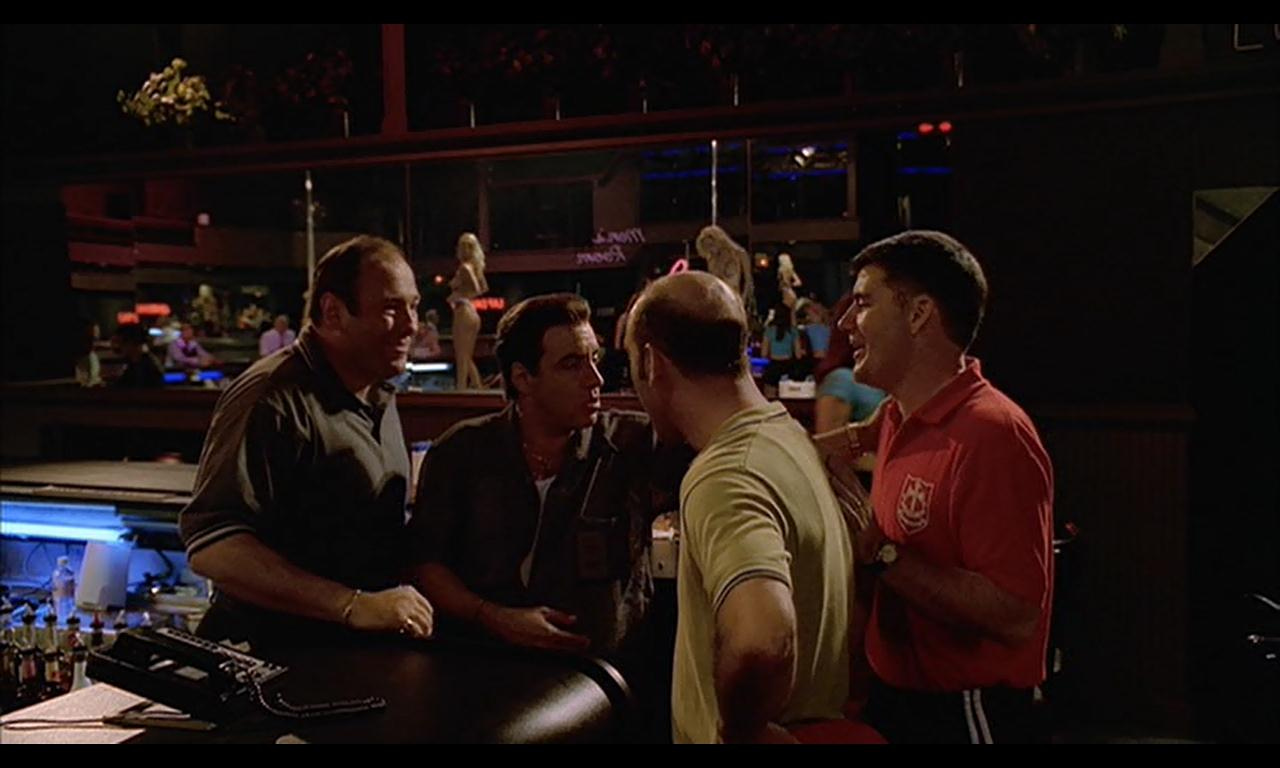
Coach Hauser (right) with Tony and the boys in Bada Bing
Hauser is visibly uncomfortable in the place, even more so when the prospect of a backroom “dance” is offered, so he makes his excuses and gets out of there.
The first inkling is that here we have two male extremes: on one hand the upstanding, law-abiding coach, inspiring his team to greater efforts and more success on the field, and on the other the organized crime bosses who embrace all the laws of the jungle and do whatever it takes — whatever it takes — to get their way, get ahead and stay ahead.
But soon we realize that all is not as simple as it seems.
It’s revealed that Coach Hauser has been having an affair with one of the girls on the team, a 16-year-old teammate of Meadow’s, and the mob’s plan turns from persuasion to punishment.
So those first two male extremes we’re presented with — the law-abiding and upstanding versus the gun-runners, the smugglers, the drug dealers and the murderers — are set aside and we get another extreme: the sexual predator.
Now you might ask: what has all this to do with self-worth and net worth, money and mindset?
And thanks for asking.
I am aware that there are both male and female readers here, and quite likely other readers on some other point elsewhere on the gender spectrum.
But no matter what your gender identity or sexual preferences, the reality is that how men show up in the world has a massive impact on the world all of us get to show up in.
If you are a man, how you show up — your state as you interface with the world — impacts all of the things that add up to the quality of your life.
If you’re not a man but you live with one, or near one, or work with or for one, the reality is that his state in his life will have a big bearing on the quality of yours.
And there’s no escaping this. We men, in general, are physically stronger, more volatile and take more risks, in everything we do.
So we can try to live in a world that doesn’t exist, or choose to learn about the one that does.
Human nature and human behavior is complex, deep, and full of terrible choices and the deepest, most inexplicable darkness.
There’s a strong argument that religion emerged in the first place as much out of a desperate human need to seek guidance from a higher power to overcome man’s most basic and most sordid instincts as it ever did out of religious or spiritual experiences.
We got new insights into man’s depraved, predatory hunger in a high-profile recent court case in France, where 72-year-old Gisele Pelicot alleges that her husband — to whom she had been married for 50 years, with whom she shared three children and seven grandchildren, and who has already admitted to drugging and raping her — recruited dozens of men online over a nine-year period to come to their home and have sex with her drugged and comatose body.
We can read about a case like this and bless ourselves or give thanks that nothing of the sort could happen in our lives.
But could it?
Depraved and sordid behavior is everywhere. In my small town in Ireland, I’m familiar with at least five cases of family sexual abuse and rape — of women and children, boys and girls — that went on over decades. Some of it only emerged after the old guy died. Others came to light after decades of secrecy, leading to fresh hurt and family splits between those who wanted justice to be served and needed the abuser to be held to account and those who had pushed it deep down and wished it never to be spoken of again.
This is in my small town and its environs, population maybe 40,000.
Is my small town especially depraved, an outlier in criminal sordidness?
I don’t think it is.
So, again, Shane, answer the question: What has this got to do with anything I’ve been writing about here? What’s it got to do with our money or our psychology?
In a word: everything.
Who we are, how we are, what we do, our capacity to respect and value ourselves and the work we’re responsible for producing, our ability to live a good life where we can contribute to the whole while nurturing and protecting those closest to us — us men carry all of this. And we carry the other thing too: we carry a heavy, heavy weight, the possibility of abuse, violence, depravity, degeneracy and predatory behavior.
It is in us, somewhere, this capacity for a grave malfunctioning that destroys not only our own small individual life but destroys the lives of others, including the ones we were most responsible for, the ones we thought we loved the most.
It must be in us. If it were not, men would never do such things. Aleksandr Solzhenitsyn, the great Russian writer of the Soviet 20th century, knew that it was in us. In The Gulag Archipelago, he wrote:
“The line separating good and evil passes not through states, nor between classes, nor between political parties either — but right through every human heart.”
One of the instincts almost every man I know feels — and, depending on your place in society, you might argue that this is 100% correct and right, or 100% a dire and damaging social construct — is a responsibility to provide for and protect those who need to be provided for and protected.
To do that providing and protecting, every man must walk the line.
On either side of that line, glaring at him and blaring at him, are shadowy opportunities, destructive temptations, illicit distractions and all the darkest recesses of the human psyche.
The only way to avoid a view of those pitfalls is never to take a step forward.
But you cannot avoid stepping forward.
To have a productive, fruitful, fulfilling and accomplished life, you must step forward.
Therefore few lives escape all of those pitfalls.
The very best of men stumble, fall to the dirt, scuff their knees, bloody their palms and hurt those closest to them, but still manage to pick themselves up, often by accepting a strong helping hand from someone further down the line.
The worst of us fall off the path, go tumbling into the abyss and never get out.
Tony Soprano was no role model, but Don Hauser’s is the life all men fear.