Other people
Is this the meaning of life?
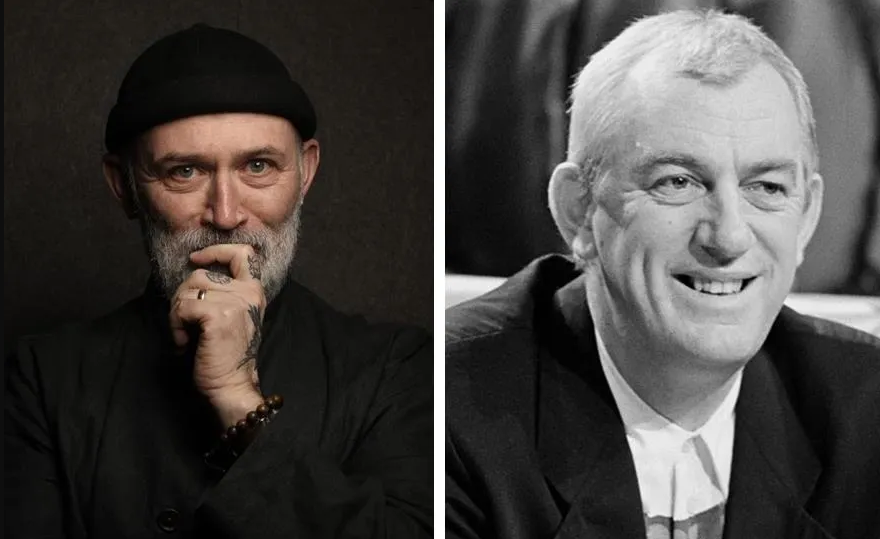
Tommy Tiernan (left) and Shay Healy
It’s strange to write this, because maybe half the people reading this are Irish and know exactly who I’m talking about, and half are not and have no idea, but Tommy Tiernan is an Irish comedian and Shay Healy was an Irish broadcaster, songwriter, journalist and entertainer.
Tiernan rubs many people up the wrong way. His shows routinely run right up to the line of controversy or go sprinting past it. In his defence, and in defence of all comedians everywhere, comedy is about much more than making people laugh. Comedy is about making people laugh about things that are vital in our civilization. By laughing — even involuntarily, even as we might be tempted to look around to see if anyone has seen us laugh — we are forcibly considering and reconsidering things essential about the way we live, or things essential to confront and change if we’re to go on living the way we’d like to.
While Tiernan continues to go strong — recently he made a well-received appearance on the podcast of American comic Bill Burr which threatens to bring him to a whole new audience — Healy died in 2021 at the edge of 78. He had also courted controversy during his working life, especially with his late night Irish television show Nighthawks, filmed through a haze of smoke and with cans of booze strewn everywhere and offering up a rebellious, almost anti-establishment voice — which, coming through the screens of the state-funded national broadcaster, was quite an achievement.
The reason I bring up both men here now is a story that came back to mind from somewhere over the past couple of days.
It was a story Tiernan told on his own podcast, either after Healy died or during his well-publicized late life struggles with the cancer that would eventually take him away.
Tiernan recalled being in a room with the ailing Healy at some awards ceremony or other, and the broadcaster, seated at a table and without much of his old strength left, beckoned to the comedian. He went over to meet him and leaned in, sensing that he wanted to impart something important. Whether it was the man’s sickness or the noise of the room, Tiernan struggled to take in the message being spoken, and leaned in further, fully sure now somehow, through the demeanor and body language of the seated man, that it would be profound, even vital.
The words he heard were, or approximated:
“Other people. Everything. It’s about other people.”
In our desperation to make a fortune or even just a living, in our tireless attempts to carve out a slice of the life that resembles even slightly the wishes for ourselves that we harbor within our minds, it is too easy too often to lose sight of the people we meet along the way.
For a few of us, those who occupy the further end of the narcissistic/sociopathic spectrum, other people are nothing more than just a means to our end.
Most of us might not drift too far along that spectrum but, if we’re truly honest with ourselves, we do spend some time there. We go through our days seeing servers behind coffee counters or drivers behind wheels without noticing anything about who those people truly are.
Worse, our drift towards narcissism picks up speed via our hyperconnected lives. More and more people are now just usernames on screens. All we see or care about is the handful of words or emojis that appear next to them.
In failing to see ourselves in one another, we come to distrust and fear one another. Groupthink and endless labelling makes this worse. We see other people not as human beings, each one the same as us and yet wholly and beautifully different in their individual uniqueness, but as members of a race, a nation, a team, a tribe or an oppressed victim group in an endless 4D pyramid game where everyone is either oppressor or oppressed and often both at the same time.
How can we see ourselves in one another when we come to distrust everything we see?
How can we build connection with those around us when we silently but routinely send a message that the anonymous username on our screens is more important than the real live person standing right in front of us?
Those two words, “other people”, quietly voiced by one entertainer to another, force us to look at the world afresh.
They force us to face the truth that while we might stand tall and straighten our backs and prepare ourselves for whatever violence or opposition the world throws at us — and all of that is good and necessary — we are nothing if we allow the ties that bind us to be torn apart in every direction.
We are in danger. We’re in danger of being split into eight billion individual nodes, all fearful and distrustful of all the other nodes.
Our wealth and our wellbeing is influenced by other people. The money in our bank accounts, every cent of it, passed through the bank accounts of other people first.
Think for a moment.
Recall a time when you felt great joy or peace or satisfaction. Were you alone? Or were you with other people?
What about love or beauty? Is it ever possible to truly experience love or beauty without sharing it with or experiencing it through others? In the greatest possible way, love and beauty is a shared experience with humanity itself, and the “other people” is everyone, all connected by some divine thread.
Beneath all of our goals in life lie the greater underlying goals of happiness, joy or peace.
Money is often oxygen on the road to these goals, but money can only be a conduit rather than the thing itself.
All the way back in 1815, William Wordsworth wrote:
Surprised by joy — impatient as the Wind
I turned to share the transport — Oh! with whom
But Thee, long buried in the silent Tomb
Wordsworth knew that any joy he felt paled quickly when he was unable to share it with his loved one.
A century of psychoanalytics and countless therapy sessions have created our direfully self-reflective times.
Self-knowledge and self-awareness are vital.
Self-occupation, though, when it comes at the expense of everyone else in our lives, paves a lonely, tortured, torturous path.
I’ve been around the world. I’ve seen many sunsets and heard many songs. And let me tell you there is nothing in this world — nothing — more beautiful than the light reflected in another human being’s eyes.