Trust Series: The trust equation
Two vital things that add up to the one thing essential in every great relationship.
There’s a phrase commonly heard in branding and marketing fields.
“The confused mind never buys.”
The thinking is that you must strive to be ultra-clear with what your brand stands for, ultra-clear on what your business offers. Because without clarity there is confusion, and the confused mind never buys.
Confusion, of course, can be overcome. It just takes a different message, a better value proposition, and hey presto, confusion disappears and clarity reigns.
What cannot be overcome is distrust.
Warren Buffett, he of all the billions, knows the potency of distrust. He once said:
“It takes 20 years to build a reputation and five minutes to ruin it.”
Reputation, here, is what’s built on trust. As well as being built on trust, a good reputation creates trust.
But it doesn’t need a bad reputation to create distrust. All that’s needed is for a reputation to be lukewarm.
If someone starts to distrust you, it’s effectively impossible to make them trust you again.
Every buyer-seller relationship is built on trust — the seller agrees to provide the promised value to the buyer; the buyer agrees to exchange the monetary value to the seller.
Distrust is toxic.
If distrust seeps into either side of this relationship, it infects the entire relationship. The relationship built up over 20 years crumbles in five minutes.
With all this mind, it will be blindingly obvious that Trust — capital ‘T’ Trust — is an essential element in any business relationship you want to last.
If you’re here reading this, I’m almost certain you’re not a stall seller hawking knock-off fake leather handbags to tourists you’ll never see again. As I touched on in my series of essays on Naval Ravikant's famous tweetstorm "How to get rich (without getting lucky)", you’ll want your business relationships to last way beyond the latest transaction.
(As Naval put it in Part 6 of that thread, “Play long term games with long term people.”)
With this in mind, then, what is it that creates trust?
A simple equation comes to mind:
Trust = Time + Truth
Many would argue, and I wouldn’t disagree, that time is the most important thing. Others might say, and I wouldn’t disagree with them either, that truth fills this role.
In the context of business, though, or work — or love or friendship or anything else that’s based on long-term relationships that are mutually beneficial in a thousand intangible ways — nothing is more important, nothing provides more solid foundations, than trust.
Time is self-explanatory. It takes time to build the trust required for deep relationships. You don’t know how much time it will take, but you can be certain that it will take time.
Truth is more problematic. After all, what is truth? Is there one truth? Does everyone, as the progressive chatter seems sometimes to suggest, bring their own truth? Some people might say that Donald Trump himself — he called his own social network Truth Social, after all — is the individual more responsible than anyone else for the so-called “post-truth world”, but I’ve seen persuasive arguments that Trump is himself a creation of the post-truth world, not its creator.
And the world around us does seem to be post-truth. Fakeness, obfuscation, gaslighting and lies are everywhere. We live in PR-land, spin doctors and controlled narratives.
Ignore the obscene levels of fakery and survive, or pay attention and go crazy. Heads I win, tails you lose.
The novel Catch-22 lampooned the insanity of World War II active service.
Catch-22 book cover poster.
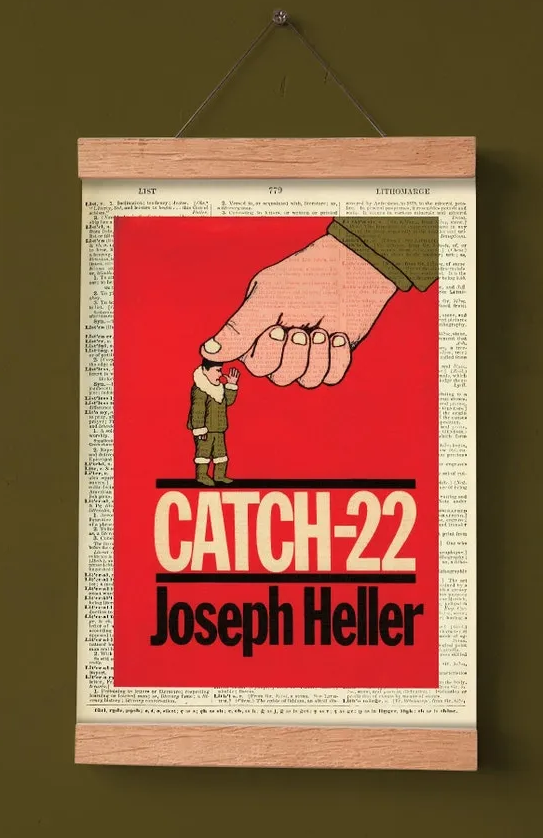 Image via Coversandquotes / Etsy
One of the most Catch-22 things of the social media age is how the idea of authenticity has itself been turned into a composable commodity. Manufactured, cookie-cutter, selfie-in-the-mirror authenticity might be the opposite of actual authenticity. Maybe there’s a literary descendent of Joseph Heller waiting to do the same for our screen-laden time, or maybe all of them have also been turned into buffoons.
So truth is problematic. It might be everywhere but still hard to find. We are so desperately inarticulate — me 100% included: I see Fee Sheet and everything I write here as one long futile attempt to write something fundamentally true — that we struggle to find the right words.
Without the right words how can we know something is true? Even on the rare occasion when we think we’ve found the right words, the other person often hears the wrong ones.
Still (and this may be naive), I have long believed that human beings have a sixth sense for truth.
Undoubtedly, many of us have not yet tuned in to that sixth sense frequency.
Many others have found the right frequency but can’t bring themselves to believe what they find there.
The best of us, those precious few, (1) see the truth, (2) see it as the truth, and (3) bring that truth into the open, knowing that it is what everyone seeks.
This, then, is the hard journey to a good life.
Truth, if we do the work of uncovering it, identifying it, believing it.
Plus time. Years, certainly. Decades, probably.
Equals trust. And all the wealth and bliss of experience to be found there.