The front of the race
What we don't see when we only see the contenders and the winners.
Some thoughts bubbled to the surface while parked on the couch for a few hours recently — and while this essay dives into sports, I promise you don’t have to be into sports to get some value out of what follows.
First, let me offer some context: I’ve never seen myself as a sports “fan”. I don’t support or follow a team. I dislike partisanship, or perhaps more accurately, I find that partisanship doesn’t align with my core values. One of my core values is that we are all individuals and, paradoxically, that we are all one. So the idea of an “us vs them” approach to sports never gives me much enthusiasm.
Instead, I pay close attention to top-level sport because of what top-level sport might teach me about living a good life, one that is whole and fulfilling and which strives to reach into the deepest inner parts of ourselves to discover how much we might be capable of. (This way of thinking led me a few years ago to a long essay, which became a short book, called Rafa Nadal Makes Me Want to Be a Better Man.)
And so, last weekend, while paying this sort of attention to two sporting events, I started thinking about this journey through life and the relationship to work / business / vocation — mine certainly, perhaps yours too, and without doubt countless people all over the world who have reached a certain age or a particular point in life when they’re figuring out what exactly they’re here to do, make or contribute over the next five to fifty years.
The two sporting events were The Open Championship, the world’s greatest golf tournament, and the Tour de France, the world’s greatest bike race.
The Open Championship takes place each July, run by The Royal & Ancient — and while we’re here, has there ever been a better name for an organization than The Royal & Ancient? — an organization which was founded in the 1750s and for more than two and a half centuries has been the central guardian, trustee and administrator of the game of golf.
The Tour de France also takes place each July, three weeks of racing from lightning quick stages through the French plains, to bone-rattling races on cobbled streets or loose gravel roads, to torturous — but always absolutely compelling — days crossing high peaks in the French Alps and Pyrenees.
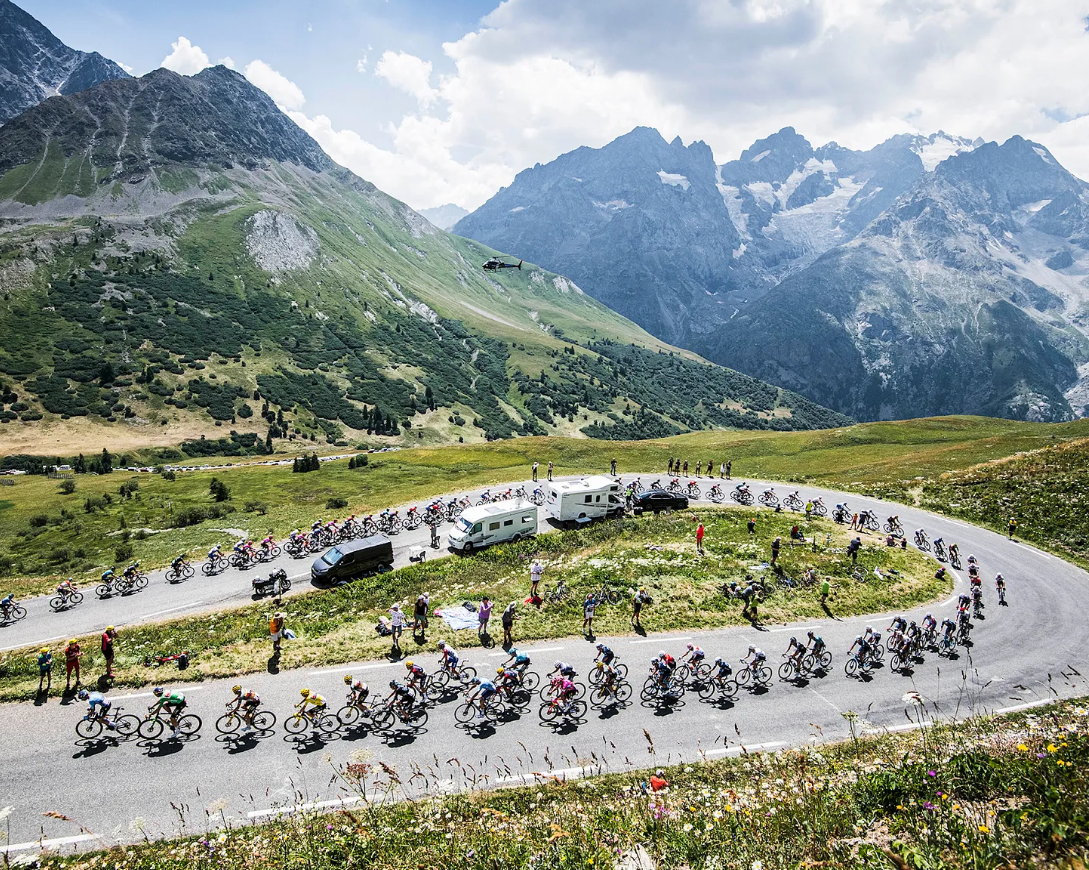 Photo via Strava / A.S.O. / Charly Lopez
In the space of a couple of hours last Friday, I started thinking about what we typically witness when we tune into these and other top-level sporting events.
We see the front of the race.
Two stories, specifically.
First, the golf.
Every golf tournament is covered by television in two obvious ways: they show the big names, and they show the leaders. (And, of course, the big names only became big names because of all the time they previously spent among the leaders.)
So you get shot after shot of Tiger Woods or Rory McIlroy, interspersed with the drives, approach shots, chips and putts of those at the top of the leaderboard. As the tournament ticks along to its conclusion on Sundays, and the big names have either climbed into contention or — as often happens, for golf is both ridiculously difficult and ridiculously competitive — dropped completely out, the coverage focuses on those who will fight it out for the title.
But in the few hours I spent watching the golf last weekend, I didn’t watch the typical television coverage. Instead, I logged onto the R&A website, where they had two live feeds from around the course at Royal Troon, on Scotland’s east coast. One feed was a featured group, which showed every shot of one of the groups of players who were making their way around the course. The other feed — they called it the “Par 3 Channel” — just showed Troon’s iconic short holes as group after group came to the tee.
One of those short holes is just over 100 yards long, no more than a flick of the wrist for the world’s top professionals who would generally expect a 100-yard shot to land within 3-4 yards of their target. On Troon’s 8th hole, nicknamed “The Postage Stamp”, the cameras and commentators were there to capture and describe the events as the tournament’s 100-plus players came through.
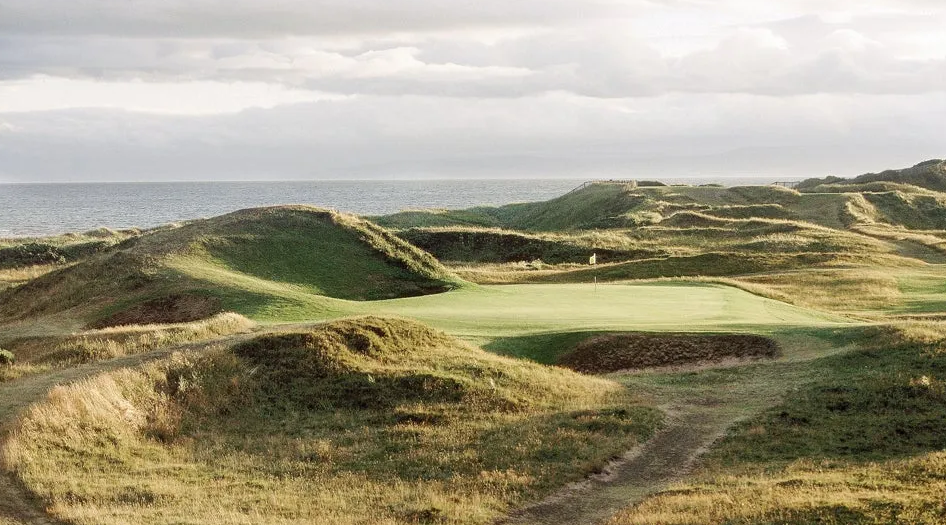 Image via Golf.com / Fred Vuich
And the thing you notice most when you’re not just paying attention to the biggest names and to those at the top of the leaderboard?
The struggle.
These are, by almost every measure, the top 1% of the top 1% of golfers in the world. They are the best of the best, the players who have built a career out of this ludicrously difficult game where another tiny fraction — maybe the top 1% of the top 1% of the top 1% — make fortunes in the hundreds of millions of dollars and many of the rest toil around various tournaments battling to make ends meet. (I remember attending one of the top amateur tournaments in Ireland years ago, and after the winning player sent a gorgeous drive fizzing into the distance at one hole, a veteran observer quietly declared that while he was a great amateur, if he turned pro he “wouldn’t earn a sausage on the Tour”.)
As player after player came to play the Postage Stamp, on a day of gale force winds blowing in from the Firth of Clyde, the struggle was etched all over their faces. A 100-yard shot became impossible to control. One of the world’s top players, the Chilean Joaquin Niemann, who signed a deal likely worth more than $10m to join the Saudi-backed LIV Golf League last year, hit his tee shot into one of the steep-sided sand bunkers that surrounded the green. From there he was unable to control his shot and he ended up in a second bunker. His next shot failed to clear the bank. His next found a third bunker on the other side of the green. The par three hole took him eight shots, four of which came from three different bunkers.
Over on the Tour de France, which was weaving its way through the Alps towards the conclusion of the 2024 race, probably more than 95% of the footage we see comes from one of two places: the peloton, the main group of riders which almost always includes the wearer of the yellow jersey of overall race leader; and the tete de la course, often a small group which have escaped up the road to try to win points along the way and maybe even, if they’re especially lucky or especially aligned in their collective work-rate, stick it out all the way to the finish line to win the day’s stage.
But occasionally in the mountains you will see some footage from the back of the race. Typically, the sprinters who fight out the finish on the flat days — big, muscular, powerful men, at least relatively speaking when compared with the wiry and light-framed racers who reach the top of the mountains at the front — find themselves way behind when the gradients get steep.
Mark Cavendish, the veteran sprinter from the Isle of Man and the holder of the record number of Tour de France stage wins — he won 35 between 2008 and 2024 — will often roll in with a group of fellow sprinters maybe 20-30 minutes behind the mountain stage winner. In this year’s overall GC, or “general classification”, Cavendish finished 141st of 141 finishers, almost six and a half hours behind Tadej Pogacar, the race winner.
On these difficult days, the sprinters and fellow strugglers race a different race. They’re not in contention to compete at the front. Their race is against what’s coming behind: the dreaded “broom wagon”, a reference to the vehicle which used to drive along way behind the race, picking up the stragglers who weren’t able to turn another pedal.
These days, the broom wagon is just a metaphor. No vehicle sweeps slow cyclists off the road, but its specter still exists: all riders must finish a stage within a certain percentage of the winner’s finishing time or be disqualified for missing the time cut.
TV producers and newspaper journalists tell the winners’ story. So most of the time, that is what we see. But when we only see the front of the race, we never see the struggles of what goes on behind.
All sportspeople, including all the greatest sportspeople, routinely experience struggles and adversity. All of them face days when the specter of the “broom wagon” casts a gigantic shadow. All of them know that for every day when they’re front and center of the coverage, there may come plenty of others when they’re scrabbling around, isolated and alone, just trying to keep things together.
Getting to see sports stars up close as they deal with their own shadows and their own struggles, and seeing them keep moving imperfectly forwards regardless, is a humbling and gratifying experience.
And it’s one which shows us, perhaps, that our own routine challenges and struggles are just our versions of the difficult and necessary days we get to experience and battle through on the way to the day we might win.