Shared narratives
Without a shared narrative of the past, we don’t know how we got here. Without one of the present, we don’t know where here is.
Without a shared narrative of the past, we don’t know how we got here.
Without a shared narrative in the present, we don’t know where here is.
A shared narrative is everything from a water cooler conversation about last night’s episode of The Sopranos to general agreement about what happened in concentration camps in World War II.
A shared narrative creates a feeling of belonging in time and in place, a sense that the past made sense, the present is ripe for the picking and the future will open out in one of a small handful of possibilities.
A shared narrative meant a sure footing on solid ground, two things we’ve needed since we told stories around fires in caves.
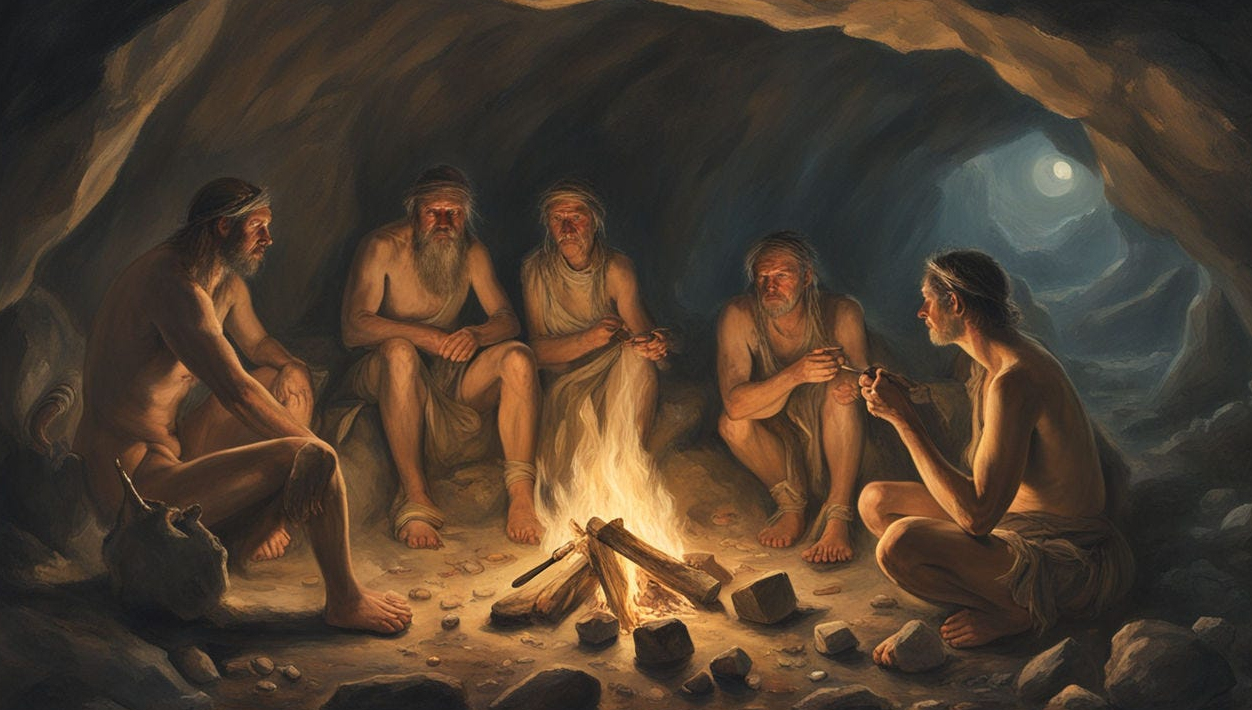
Image via AI Hybrid / Deviant Art
Our shared narratives, and all shared narratives, are gone and gone forever.
The past is revised and revisited and redefined over and over again, so much so that you doubt everything you used to know.
For just one of a million examples, you see rampant money-printing by government central banks and federal reserves, and then you see the out-of-control inflation you expected — because that day in history class in school years ago, when quantitative easing was discussed, you paid attention — but then you see the experts and advisers and television talking heads say that this inflation is “transitory”.
And you shake your head.
You shake your head in growing frustration and deepening rage, mad as hell at the narrative rug-pulling that’s going on to try to make you question your own eyes and ears and judgment.
Or maybe you shake your head just to try to clear it, because you think you must be imagining all this, because you think you must be asleep and this must be a bad dream, because you think that any day now the lunatics will be run out of the asylum by the adults who have come back to take control.
But you don’t wake up because you’re not imagining it — or is that what a 3D dream like this would make you think?
So you don’t recognize the past you lived and learned about.
There’s no escape in the present either, because the present is dissolute and scattered. Nothing you see is the same as what anyone else sees. Apart from the Super Bowl and Presidential election night and a handful of other hours-long moments every few years, we walk around every day with almost nothing in common with anyone else. There are people who are celebrities to you who 99.999% of other people could not pick out of a line-up.
The present is so dissolute and scattered that you look around and wonder just when did it happen that everyone went insane. And then you realize — with a mounting horror, with that terror that came when you were a schoolkid and the mob had gathered round you in the playground, when you knew what it felt like to be completely and absolutely without power — you realize that not only does everyone around you look and act insane to you, but that you look and act every ounce as insane to them.
Everyone looks and acts insane to everyone else, in a kaleidoscopic hall of mirrors that’s like a film made by Alfred Hitchcock and David Lynch and Yorgos Lanthimos, where the uncanny is so ever-present that in some odd way it tries to suggest that it is not uncanny, it is real.
Shared narratives started dissolving with the mainstreaming of the Internet two decades ago.
The Internet, and everything built on top of it — Bitcoin to Uber, Tinder to ChatGPT — is humanity’s vanishing point: the point in time when everything afterwards is all changed, changed utterly.
As I wrote in “The vanishing point”,
“The opportunity is vast. All of us can build lasting relationships, create saleable items and get paid from anywhere in the world, with just an everyday computer and a decent Internet connection.
The size of the opportunity is directly proportionate to the size of the imagination.”
Just because the opportunity is vast does not mean that the trapdoors are not deep and dark and present at every footstep.
The loss of shared narratives presents as big a challenge to our lives as the vastness of the possibilities presents unprecedented opportunity.
When no shared narratives remain, everything that was previously shared and agreed upon becomes a battleground staging a fresh fight.
Without shared narratives, we cannot get a foothold or a handgrip, and if we fall, the fall might last forever, tumbling into an infinity black hole where the only release is… what?
Death? Madness? Something worse than both?
And yet.
The pain of the vanishing point — much of it resulting in and rising from the death of all the shared narratives we once held — must hold a seed of rebirth.
This is the driftwood in the storm.
We cling to it because we must. It’s our only hope.
We have no idea what’s next.
Infinity both directions.
The downward pull of gravity is strong and our fingertips are screaming.
If we let go, what are the chances that we soar?