What the Paris Olympics can teach us about the world
For months after the 2024 Olympics, I wasn't able to get it out of my mind. This essay is my attempt to explain why.
There’s a great TS Eliot poem of the early 20th century, “The Love Song of J. Alfred Prufrock”.
The poem’s original title was “Prufrock Among the Women”, which hints at its subject matter — a poem about an ordinary everyday failure of a man and the incessant chatter of his innermost desires unrealized and lingering regrets for all the opportunities missed.
It is an extraordinary poem, not least because TS Eliot was just 21 when he wrote it. (In that way, it’s a bit like Jackson Browne’s song “These Days”, a song which deals with the regrets of life and love — “These days I seem to think a lot / About the things that I forgot to do for you / And all the times I had the chance to / And I had a lover / But it's so hard to risk another, these days”. When he wrote the song in 1964, Browne was 16.)
As poems go, Prufrock is not exactly an easy read, but like the best works of art, it has layers and depths that reward you each time you return to it. There’s one line in there that’s come back to mind repeatedly over the past couple of months.
“I measured out my life in coffee cups.”
I, for decades, have measured out my own ordinary life and its own ordinary failures in four-year Olympic cycles.
Indulge me.
Seoul in 1988: Sitting with my family — us children all still children, parents still together and still happy enough, or so it seemed, even just a few years before the cataclysm of marital and family separation. I remember watching the final of the men’s 100 meters, gazing in awe as Ben Johnson, the Canadian sprinter, muscles and yellowing eyeballs bulging, punched the air while breaking the world record in 9.79 seconds. I recall the news a day or two later, scandal breaking as Johnson was found to have steroids in his system. (That race in Korea is now widely seen as the dirtiest ever run.)
Barcelona 1992: My family splitting apart at the seams, the final few weeks in the house that was our home since we were born, Freddie Mercury singing the city’s name and the Olympic flame lit by flaming arrow. That home was an idyll of a small house in the country beside a farm field with a small pond in the corner where I must have knelt for days on end, because I remember how a gluey mass of frogspawn one day erupted into a shoal of swimming tadpoles the next.
There was no room for frogspawn in my father’s new house, a semi-detached in a housing estate in the town. There, the laddish chatter on street corners and in unfamiliar sitting rooms was played out against a soundtrack of Red Hot Chili Peppers music: their album Blood Sugar Sex Magik was fresh and new, MTV had brought “Give It Away” and “Under The Bridge” into our consciousness, and Chubby Lee was the coolest boy I’d ever known or ever would, who carried a ghetto-blaster to the green in the middle of the estate and who five years later would be dead, one of three friends killed in a car accident before he could ever become a man.
That summer of 1992 was all American: the Chili Peppers, MTV and basketball. All the young teenage boys who lived in the estate talked about the “Dream Team”, the US basketball superstars of the NBA — Michael Jordan, Magic Johnson, Scottie Pippen, athletic giants of black men unlike anything anyone had ever seen around our small Irish town — who had come to Barcelona, a sort of exhibition team putting amateurs from around the world to the sword on their way to the gold medal.
That summer was _almost _all American.
That same month, a big part of 14-year-old me fell in love with a 17-year-old Hungarian swimmer called Krisztina Egerszegi, each one of her three golds in the pool bringing a smile that melted the heart of this Irish boy a thousand miles away.
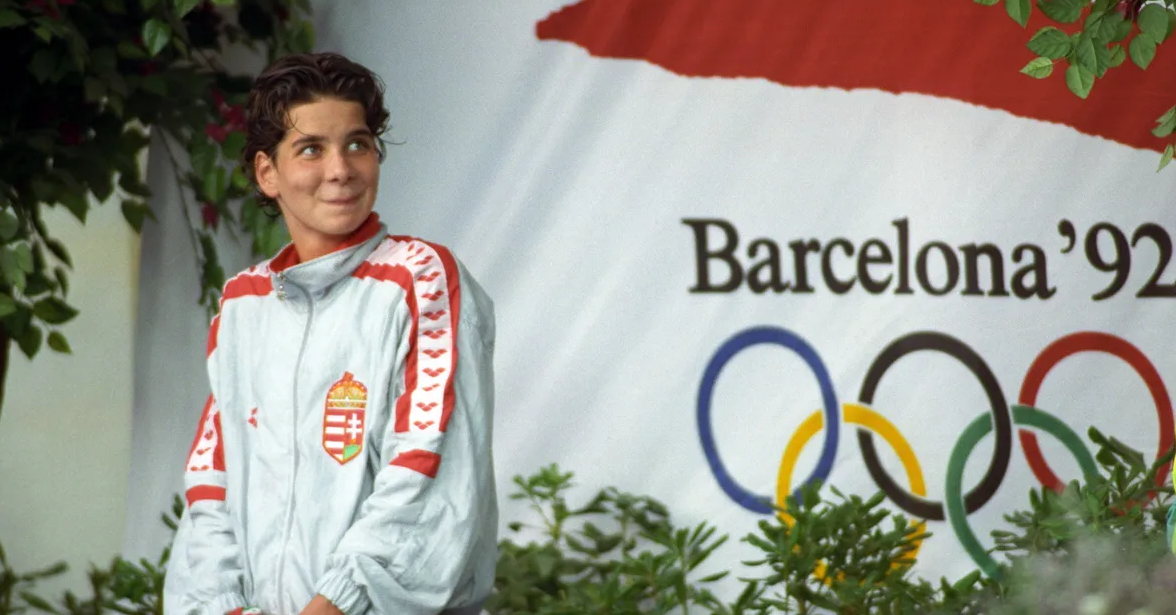
Krisztina Egerszegi
Atlanta 1996: Michael Johnson breaking the 200m world record, and Ireland’s Michelle Smith winning three swimming gold medals amid suspicions that she wasn’t doing so entirely clean. As I started out in college, drawn both by the athletic accomplishments and corruptions and the people who wrote about both so compellingly, I set myself the goal of working as a sports journalist at the Sydney games four years later. I did not make it to Sydney to see Ian Thorpe in the pool or Cathy Freeman in the hood. Instead, working my first journalism job — for a small magazine press, operating several leagues below the writers I looked up to — I went with a crowd of colleagues to a local pub at breakfast time to see Gabriela Szabo beat Ireland’s great hope Sonia O’Sullivan in the 5000m final.
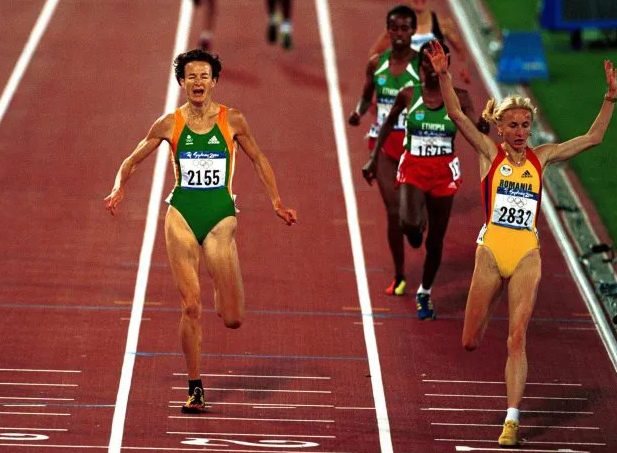
I have unforgettable memories of so many Olympic Games, but somewhere along the way real life seemed to intervene and the romance of it all died or was hoovered up. London 2012 was a momentary beacon, sweeping up even us Irish in a long list of Great Britain’s great Britons — Jessica Ennis, Mo Farah, Chris Hoy, Andy Murray — and in the boxer Katie Taylor bringing us a hero of our own. I remember, this above all, bottle-feeding my then nine-month-old son to sleep, still reeling from the new reality of fatherhood. Rio in 2016 is a black hole in my mind, coming the same summer that my life came off the rails. For Tokyo in 2021, the Covid games played out like a horror movie in front of empty stands and deserted streets, I was on holiday elsewhere and scarcely gave it a passing thought.
So if you’d have asked me a few months ago whether I was looking forward to the Paris Olympics, I would have been lukewarm. I’d watch it, probably, whichever parts of it grabbed my attention, but it would probably pass me by, amid client deadlines and everyday failures and bigger fish to try to fry.
The gods have other ideas.
For the two weeks of the Paris games, events aligned. I was laid up with a heavy chest cold that was fast becoming a pneumonia which prevented me from doing much of anything productive but did allow me to lie down on the couch and watch events from Paris, most mornings to most evenings.
There is much that seems to be bad about the Olympics, or more specifically the International Olympic Committee which runs the Games. The IOC seems to be a political organization more than a sporting one, and political organizations often find themselves involved in political wars; one such war broke out as two boxers banned from boxing’s world championships last year for failing gender tests were permitted to take part in the women’s event. Such gender controversy shouldn’t have been a surprise — it was evident in the opening ceremony too, when a bearded man in a dress, with large and barely covered breasts, seemed to play the central role in a weird enactment of The Last Supper as torrents of rain cascaded on the Seine.
But then the Games started and the Games took hold.
For two weeks the state in which I lived my days was mostly awe.
Just two hours into its very first morning, a very strange thing happened: synchronized diving brought tears to my eyes.
Two young British women, Yasmin Harper and Scarlett Mew Jensen, had given their all and after their last dive stood in third place, but their hopes of winning that bronze medal were slipping away fast as their Australian opponents, who hadn’t put a foot wrong, just had to execute even an average dive on their final attempt. But one of the Aussie girls inexplicably slipped on the springboard and the Brits were catapulted to an unexpected medal. Immediate tears in Paris, and, in ways I am still trying to explain, here too.
That very first morning, as I switched on the TV for the beginning of the coverage, viewers were treated to the BBC’s gorgeously animated and gloriously soundtracked intro sequence. That music and those images will accompany me for the rest of my days.
Over the next two weeks, I — a straight white male, who seems to find a new Krisztina Egerszegi occupying his thoughts every few years — felt something I can only describe as love for two young men: Leon Marchand, the extraordinary 22-year-old French swimmer, whose breaststroke events gave the hair-raising spectacle of a packed Paris arena cheering loudly every time Marchand’s head rose from the water; and Letsile Tebogo, the 21-year-old sprinter from Botswana who lost his mother at the age of just 43 earlier in the year and dedicated every win to her memory, including the 200m final when he shocked everyone by lowering the colors of the three great American hopes.
Swimming and track & field are always the primary focus of the Games, occupying prime time each night, but gymnastics grabs anyone who will pay attention too. The rivalry and friendship between Simone Biles, America’s greatest of all time, and the Brazilian Rebeca Andrade, in every event was a sight to behold: Biles won three gold medals but could manage only silver behind Andrade on the floor exercise.
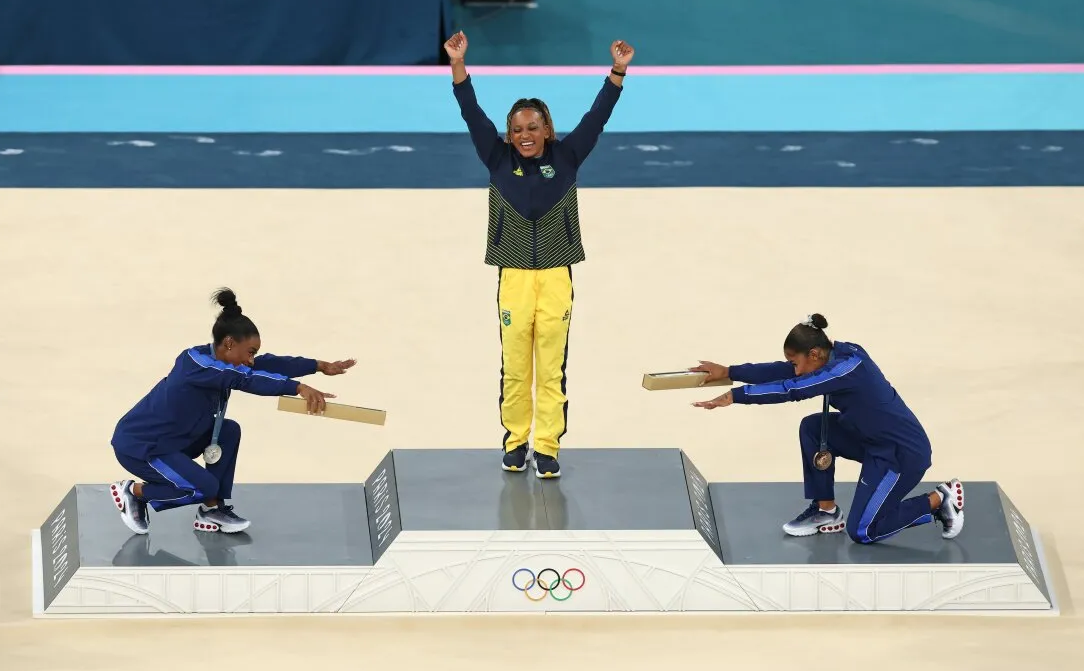
America’s Simone Biles (left) and Jordan Chiles make an impromptu podium tribute to Rebeca Andrade after winning gold medal for the floor exercise.
Other much more marginal sports also claimed my attention and wouldn’t let go. BMX, skateboarding, climbing and surfing all inhabited my consciousness for hours on end.
In our screen-scroll-tap-click culture, I discovered something profoundly soothing in throwing the phone in a drawer and watching late at night as two surfers in faraway Tahiti lay flat on their bellies and paddled in circles for twenty minutes waiting for the perfect wave.
Witnessing excellence always exerts a drug-like impact on me, but the high I felt for those two weeks was not just from witnessing excellence.
Much more than that, it was witnessing thousands of athletes' tireless striving to reach their potential.
Most of all, it was witnessing the everlasting beauty of seeing someone, anyone, having worked for so many hours and so many years on so many dark mornings, behind closed doors or in driving rain, alone or with the steady gaze of a coach upon them, manage to deliver the best performance of their lives on the one night when everyone’s watching.
On top of all of this endeavour, adulation, success, failure, sweat and grit, blood and beauty, it was the Olympics’ final night that really brought home to me just what these Games stood for, and what precious thing they told me about the world I live in.
Closing ceremonies are often at best bittersweet, drawing attention to all the good things that have been and are no more, and at worst an indulgent waste of time, money and fireworks. They are usually a too-choreographed signal that the sport, which is all drama and zero choreography, and which has played out before our eyes for two whole weeks, is now finally over and will never be again in quite the same way.
But the Paris closing ceremony won me over almost instantly and held me engrossed for three hours.
It was magical. It cast a spell on our living room, as the four of us — including our children, now 15 and 12, neither nearly as obsessive about sport as I was at their age — gathered half-attentive at 8pm on a Sunday evening. Three hours later, lights out, we were rapt in every second.
We were enraptured by every moment in the Stade de France as France did that almost indescribable thing that it does best: some winning combination of pride and confidence and slowness, the absence of razzmatazz a feature not a bug because France has always had that je ne sais quoi, a dedication to time-honored mastery alloyed to a habit of never, ever craving your attention.
We were enraptured, too, with every loud, street-smart moment from the United States west coast when the show cut to Venice Beach in California as part of the handover to LA, host city for 2028, which included performances from Dr Dre, Snoop Dogg and the Chili Peppers, who again showed up in my Olympic frame.
Watching from Ireland, this contrast between Paris and Los Angeles struck me in all its force, and yet there was something congruent about it too, something wholesome in the expression of a global western consciousness, a global western togetherness.
This is what the entire Olympic games experience, and especially those final few hours of showtime from Paris and LA, brought home to me.
Paris and LA occupy two flanks of the great western experiment that has brought so much good, so much opportunity, so much prosperity, to billions of people’s lives. There are many who would argue, and argue persuasively, that alongside this good, the west has also inflicted much evil and hardship on the rest of the world, through colonialism, extraction and the military-industrial complex. And there is of course much truth in that too — the world is heaving and complex and there are no easy or simple solutions, descriptions or prescriptions for all of its problems.
But sometime over the past 100 years, a western ideal was created, and the Olympics sit at the center of that ideal. It focuses a twin spotlight at once on both the collective (nationhood, organization, committees, competition) and the individual (the meritocracy of the medal ceremony, the importance of personal bests, national and world records, the “fitter, faster, stronger” ethos).
If Paris 2024 leaned one way, it was proudly for the people, for an intangible global collective. Even as it shone the spotlight on Leon Marchand, Letsile Tebogo, Simone Biles and all the rest, Paris 2024 showcased a commons that is in terrible peril and must be protected. The individual success, for the most part, was humble rather than glorious. Even when Noah Lyles, the brash American sprinter and the current epitome of the individual over the collective, won the 100-meter dash, it was in a race where the entire field was covered by just 0.12 of a second, the eight men crossing the line in a bunch in the greatest collective 100-meter race in history. Likewise, Paris 2024 was achieved with the support and togetherness of countless volunteers putting in countless hours. The whole thing stirred something dormant in me, some realization that we are all in this thing together, that nothing worthwhile can be achieved alone, that the greatest among us is useless without the contribution, support and energy of everyone else.
LA 2028 and the entire broader Internet-influenced and technology-run culture of the past two decades leans towards the individual. It’s the cornerstone of the American dream: work hard, make good, enjoy the spoils. That American dream, the best and the worst of it, has been catapulted on the world by Silicon Valley investment, connected devices and superfast data downloads, imposing a pace of change that’s been difficult to quantify and impossible to withstand. This Internet culture is, increasingly, about you against everyone else and everyone else against you. The most problematic part of this culture has been the erosion and destruction of the commons and the communities that once offered nourishment to all of us. Without the commons and communities that were so precious, the broke and the impoverished are forced to fight with one another for a tiny piece of the pie, a pie that the 1% of the 1% eat from so gluttonously.
There is a danger in going to the extremes of these two philosophies.
Too much individualism and you get a war of all against all, every man for himself, cut-throat and ruthless, hungry and unhappy (no matter how much food you have in your fridge).
Too much collectivism and you lose the beauty of the individual, you lose the striving and reward that is at the core of who we are, you lose the heart of what makes us human.
The Olympics, for all its faults, manages better than anything else in the world to balance both sides of this impossible scales. At some point, not too many years ago, I and many others wondered whether the Olympics were an anachronism, old school and irrelevant and almost certainly corrupt.
Now I believe, as much as I’ve ever believed in anything, that we must cherish and protect the Olympic Games. Because the Olympics are a symbol of our best ideal. Because a world without both the individual and the collective working together, where this dance of one for all and all for one brings such joy, wonder and inspiration to billions, would be a poorer world for everyone everywhere who wants goodness and truth and beauty in their lives.
Let’s give the last word to the BBC montage that closed its two weeks of coverage.
Thanks for reading.